
How to increase deep sleep, and what actually moves it
For a long time I thought deep sleep was something you got more of by sleeping longer. Ten hours in bed, more deep sleep. It does not work that way, and the reason changes which levers are worth pulling.
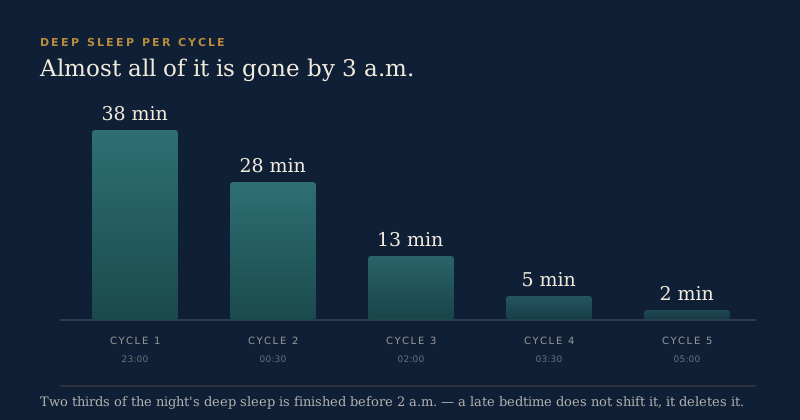
Deep sleep (slow-wave sleep, stage three) is not spread evenly across the night. It is front-loaded, and steeply so. The first 90-minute cycle carries the largest share, the second a bit less, and by the fourth there is almost nothing left. That front-loading is tied to the moment you fall asleep, not to the clock: a later bedtime with the same sleep length keeps most of your deep sleep. Cutting the night short mainly costs REM. [1]
What the distribution actually looks like
Across a normal night, most slow-wave sleep happens in the first two sleep cycles, roughly the first three hours after you fall asleep. The later cycles fill up with REM instead, which matters for memory and mood, but does not do the specific work deep sleep does.
Figure 1
Deep sleep is front-loaded
- First cycleThe largest share of deep sleep. The first cycle runs about 90 minutes.
- Second cycleA bit less.
- Later cyclesMostly REM; by the fourth, almost no deep sleep left.
That work is worth naming, because it explains why the loss is felt so physically: growth hormone is released in pulses tied to slow-wave sleep. Animal studies suggest the brain’s waste clearance (the so-called glymphatic system) is linked to deep sleep, though recent work disputes this. [3] Blood pressure and heart rate drop to their lowest point of the 24-hour cycle. Skip it and you wake up technically rested and physically wrecked.
The four levers that actually move it
Most advice about deep sleep is about sleep in general. These four are the ones worth pulling first.
1. Keep the schedule steady
Slow-wave pressure builds with every hour you are awake, and your body clock likes a predictable night. A consistent schedule is linked to better sleep overall. It’s the swing, not just the average, that matters. If you change one thing, change the variance.
2. Help your core temperature fall
A falling core temperature goes hand in hand with falling asleep. A cool room and a warm shower 1–2 hours before bed help. [4] The cool room does most of the work. We covered the range in the bedroom temperature piece. The shower drives blood to the skin, and the cooling afterwards is steeper than if you had done nothing.
3. Alcohol is the most common sleep disruptor
This one is unpopular. Alcohol makes you fall asleep faster and can even raise deep sleep early in the night, but it delays and cuts REM and fragments the second half. [2] It is the easiest way to sleep eight hours and still wake up under-recovered.
4. Late training costs more than early training
Exercise raises deep sleep, but timing decides how much of that you keep. Vigorous sessions ending less than an hour before bed leave core temperature and adrenaline elevated exactly when the drop should happen. The evidence on evening training is more forgiving than most people assume, but the last hour is real.
Figure 2
The four levers
- Steady scheduleChange the variance first.
- Cool downA cool room, and a warm shower well before bed.
- Skip the nightcapIt cuts REM and fragments the second half.
- Train earlierFinish vigorous sessions more than an hour before bed.
What does not work
Sleeping in on the weekend does not repay it. The deep sleep you missed on Tuesday is not waiting for you on Saturday. Some rebound happens on the following night, but it does not accumulate into a bank you can draw on later.
And supplements are a smaller lever than the four above. Magnesium has modest evidence at best (one recent trial of magnesium bisglycinate found a small benefit for self-rated insomnia), and no capsule compensates for a bedtime that moves by two hours and a glass of wine at eleven.
The one-sentence version
Deep sleep is not something you get more of by staying in bed longer. It is something you get by sleeping enough, at a regular time, in a cool room, without alcohol, so your body can do what it was going to do anyway.
[1] Dijk, D.-J. & Czeisler, C. A. (1995). “Contribution of the circadian pacemaker and the sleep homeostat to sleep propensity, sleep structure, electroencephalographic slow waves, and sleep spindle activity in humans.” Journal of Neuroscience, 15(5), 3526–3538.
[2] Ebrahim, I. O. et al. (2013). “Alcohol and sleep I: effects on normal sleep.” Alcoholism: Clinical and Experimental Research, 37(4), 539–549.
[3] Miao, A. et al. (2024). “Brain clearance is reduced during sleep and anesthesia.” Nature Neuroscience, 27(6), 1046–1050.
[4] Haghayegh, S. et al. (2019). “Before-bedtime passive body heating by warm shower or bath to improve sleep: a systematic review and meta-analysis.” Sleep Medicine Reviews, 46, 124–135.
Deep sleep has several levers that compound night after night. The Deep Sleep Guide puts the core levers in one plan (light, rhythm, wind-down, bedroom), plus what to do when you lie awake at night and a printable sleep log. 16 pages, €4,99.
GET THE GUIDE →Tools we rate for this. Some are affiliate links, so we may earn a small commission if you buy through them, at no extra cost to you.
Comments
0 comments