
Does exercise before bed ruin your sleep?
For about a year I had a rule I never once questioned: nothing after seven. I’d get home at half eight, look at the kit bag by the door, and go: nope. Too late. I’ll wreck my sleep.
So I just didn’t train. For weeks at a stretch, sometimes.
Which is an enormous number of skipped sessions for a rule I’d never actually checked. So I finally went and checked: does exercise before bed ruin your sleep? I was half expecting the research to pat me on the head and tell me I’d been sensible. It did the opposite. Kind of aggressively.
Does exercise before bed ruin your sleep? What 23 studies say
The cleanest answer I found comes out of ETH Zurich. Stutz and his colleagues went looking for every study where healthy adults did a single evening session and then had their sleep properly measured: not self-reported the next morning, measured, in a lab, with electrodes. They screened nearly twelve thousand papers and ended up pooling twenty-three of them.[1]
Their conclusion, in careful academic phrasing, is that the evidence does not support the idea that evening exercise harms sleep. And then they add, almost as an aside: rather the opposite.
Rather the opposite. I read that line about four times.
The counterintuitive bit: the night gets denser, not worse
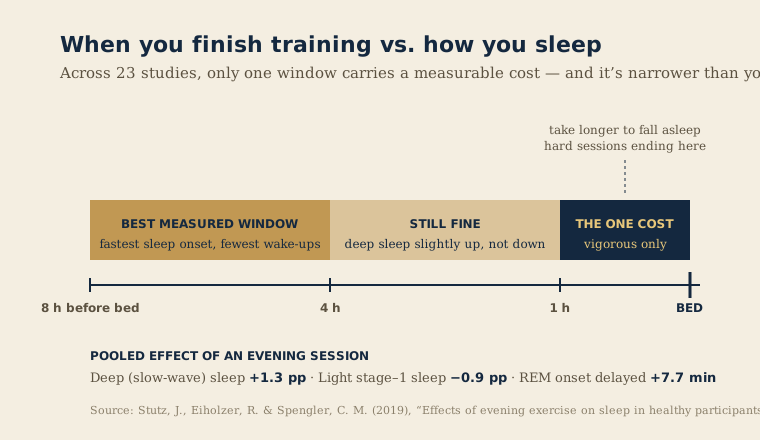
Here’s what the pooled numbers actually showed. After an evening session people got more slow-wave sleep (the deep, dreamless, physically restorative layer) by about 1.3 percentage points of the night. And they got less stage-1 sleep, which is the barely-asleep layer, the one where you’d swear you’d been staring at the ceiling the whole time.[1]
So the night doesn’t get worse. It gets slightly… denser. Less time skating the surface, more time in the layer that does the actual repair.
Small numbers, honestly. A percentage point of a night is a handful of minutes. But the direction is the whole story here, because the direction is the exact opposite of the thing I’d been organising my entire week around.
One thing did move in an unwelcome direction: REM took about eight minutes longer to show up.[1] Which sounds ominous and mostly isn’t. REM loads up in the back half of the night anyway, and nothing in the pooled data suggests you end up with less of it overall. It just queues behind the deep stuff.
Figure 1
After an evening session: a slightly denser night
- +1.3 pointsmore slow-wave (deep) sleep, as a share of the night
- Lessstage-1, barely-asleep sleep
- About eight minuteslater start of REM
And this isn’t one lonely paper shouting into the wind. In his book on sport and sleep, the researcher Daniel Erlacher walks the same ground and lands in the same place: the endlessly repeated claim that training hard close to bedtime ruins sleep by firing up the stress system simply cannot be confirmed when people go looking for it.[2]
He points at a small Japanese study where the same participants trained at three different times of day. The ones who went from half eight to half nine in the evening fell asleep faster and got more deep sleep than when they trained in the morning, or even at half four in the afternoon.[2]
The late session won. Nobody was expecting that one either.
The one window where there really is a cost
Okay. Not a free pass, though. There is exactly one place where the data turns on you, and it’s worth being precise about it, because it’s much narrower than the folk rule.
That same meta-analysis found that when a session was vigorous and ended an hour or less before bed, sleep onset, total sleep time and sleep efficiency could all take a hit.[1] Not everyone, not every night. But that’s the zone where the warning has teeth.
One hour. And vigorous. That’s the real rule. Not “nothing after seven.”
The analysis also hinted at what predicts trouble: your body temperature when you got into bed. The warmer people were at bedtime, the worse their sleep efficiency and the more they woke up during the night. Treat that as a fragile hint, though: it vanished when a single study was removed from the pool.[1]
There’s a second hint, just as fragile and the kinder one: intensity relative to what your body is already used to seemed to matter. A hard hour for a body that trains four times a week is a Tuesday. The identical session dropped on someone who hasn’t moved in three weeks is a shock. Same watts, completely different night.
Why the myth felt so true anyway
And this is the part that reframed it for me: the mechanism everyone cites is real. People just point it at the wrong thing.
Exercise raises your core temperature. Falling asleep requires your core temperature to fall; that drop is more or less the starting gun. So if you finish a hard session and climb straight into bed still radiating heat, you’ve stood in front of the starting gun. You will lie there.
But notice what the actual culprit is. It was never the training. It was going to bed hot. Those are two different problems and only one of them requires you to skip the session.
Erlacher adds the timing detail from the observational work, and it’s weirdly reassuring: sessions finishing four to eight hours before bed showed the biggest improvements in how fast people fell asleep and how little they woke up, better than sessions much earlier or much later.[2]
Four to eight hours before bed. If you sleep at eleven, that’s a session between three in the afternoon and seven in the evening. Which is, roughly, when every working adult on earth actually trains.
Figure 2
Where the real cost sits
- Four to eight hours before bedBiggest improvements in falling and staying asleep, in observational data.
- Later, but more than an hour before bedNo harm in the pooled lab data, rather the opposite.
- Vigorous, an hour or less before bedSleep onset, total sleep and efficiency can take a hit.
What to do if the evening is the only slot you have
So, the honest version of the protocol. Four things, in order of how much they matter.
Leave the hour. Finish more than sixty minutes before you want to be asleep. That single buffer moves you out of the only zone the data flags. If the class ends at nine, bed at ten-thirty, not ten.
Get the heat out. This is the mechanism, so treat it like one. A lukewarm-to-cool shower after the session, and a bedroom that’s properly cool. I went down the whole rabbit hole on the temperature that actually lets you drop off, and it turns out to matter more than most of the supplements I was stacking at the time.
Don’t stack a shock on an untrained body. If you haven’t trained in a month, your comeback session at nine at night is not the one to prove something with. Relative load is what the data hinted at.
And deal with the light. This is the one nobody mentions, and it’s the one I’d actually underestimated. Gyms are lit like operating theatres. An hour of that at nine at night, plus the phone on the way home, is a fairly aggressive message to a body clock that’s trying to wind down. The training didn’t keep me up. The lighting had a decent shot at it.

Disclosure: Amazon affiliate link · I only point at gear I actually use.
And keep the bedtime itself fixed while you’re at it. Training late is survivable; training late and letting your whole schedule drift is a different animal. That’s the one that needs an actual reset.
The thing nobody tells you
The rule cost me far more than the sessions ever would have. That’s the bit that actually stings, honestly. A year of skipped training, and skipped training is itself one of the more reliable ways to sleep badly, since fitter people demonstrably sleep deeper.[2] I was protecting my sleep by removing one of the things that improves it.
So: does exercise before bed ruin your sleep? No. Going to bed hot, wired and lit up twenty minutes after a brutal session might. And the fix for that isn’t skipping the session. It’s putting an hour, a cool shower and a dark room between the two.
Embarrassingly simple. Almost insulting. Same as always.
[1] Stutz, J., Eiholzer, R. & Spengler, C. M. (2019). “Effects of evening exercise on sleep in healthy participants: a systematic review and meta-analysis.” Sports Medicine, 49(2), 269–287.
[2] Erlacher, D. (2019). Sport und Schlaf. Springer.
Training time is one lever. The Deep Sleep Guide puts the core levers in one plan (light, rhythm, wind-down, bedroom), plus what to do when you lie awake at night and a printable sleep log. 16 pages, €4,99.
GET THE GUIDE →Tools we rate for this. Some are affiliate links, so we may earn a small commission if you buy through them, at no extra cost to you.
Comments
0 comments