
How sleep turns today into memory
You do not store a memory at the moment you make it. You store a draft. What turns the draft into something you still have in a month happens later that night, while you are unconscious and not participating.
I find this genuinely strange every time I think about it. The work of learning is done after the learning stops.
The replay
When you learn something, a pattern of cells fires in the hippocampus, the brain’s short-term holding area. During deep sleep that same pattern fires again, in the same order, several times faster than the original. Over and over, hundreds of times a night.
Each replay strengthens the version stored in the cortex, where things live long-term. The hippocampus is a notepad; the cortex is the archive; sleep is the transfer. [1]
Figure 1
Notepad to archive
- LearnA pattern of cells fires in the hippocampus.
- Deep sleepThe same pattern fires again, in order, several times faster.
- Replay, over and overEach replay strengthens the copy in the cortex.
- StoredThe memory now lives in long-term storage.
This is why a night of bad sleep after studying costs you more than a night of bad sleep before. Before, you learn less efficiently. After, you lose what you already had.
Different stages, different jobs
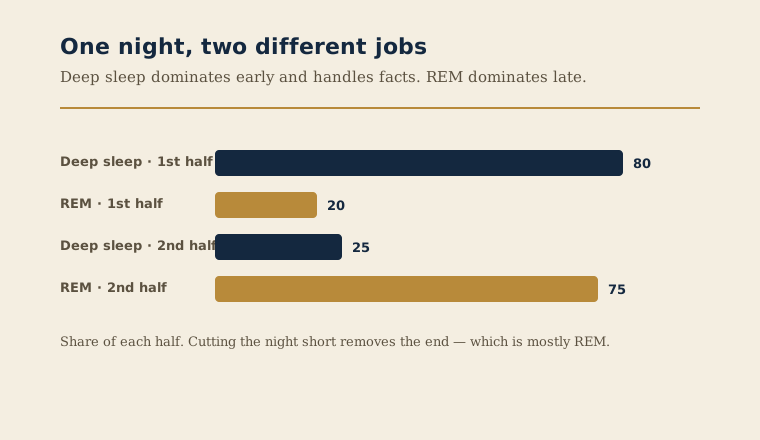
A night is not uniform. Deep slow-wave sleep dominates the first half; REM dominates the second. They handle different material.
- Slow-wave sleep: facts, names, events. The things you could write down. This is when the replay-and-transfer work happens.
- REM sleep: motor skills, pattern-finding, and taking the emotional sting out of memories while keeping the content.
The practical consequence is uncomfortable: cutting your night short doesn’t remove a uniform slice. It removes the end, which is disproportionately REM. Sleep five hours instead of eight and you keep most of your deep sleep but lose a disproportionate share of your REM.
Figure 2
Two halves of the night, two jobs
First half: deep slow-wave sleep
- Facts, names, events
- The replay-and-transfer work
- Mostly kept when you sleep less
Second half: REM sleep
- Motor skills and pattern-finding
- Takes the emotional sting out of memories
- Lost first when you cut the night short
Spindles
During non-REM sleep the brain produces short bursts of fast activity called sleep spindles (a second or two each, thousands per night). Spindle activity rises after learning and has been linked to next-day recall. [2]
You cannot train spindles directly. But they occur throughout non-REM sleep, especially stage 2, which means the things that protect a full, unbroken night (a cool room, no alcohol, a consistent bedtime) protect them by proxy.
Naps count
Consolidation isn’t reserved for night. A nap containing slow-wave sleep produces measurable consolidation. In one study, a 1-hour nap and an hour of extra cramming both helped at first, but a week later only the nap group still outperformed people who had simply taken a break. [3]
Short naps of 10–20 minutes restore alertness but generally do not reach deep sleep. Useful for a different problem.
What this changes about how you learn
Study before sleep, not before a gap. Material learned shortly before sleep is kept better than material followed by a long day awake. [4]
Stop cutting the last 90 minutes. Those are the most REM-dense of the night and the cheapest thing in the world to give away.
Spread it out. Four evenings of thirty minutes beats one evening of two hours, because you get four nights of consolidation instead of one.
Alcohol is the specific enemy here. It delays and reduces REM early in the night and fragments the second half, disrupting precisely the stage doing the skill and emotional work.
The uncomfortable summary
You can be disciplined about studying and still lose most of it, because the part you were disciplined about is the smaller half of the job. The other half happens in the dark, unsupervised, and the only thing you control about it is whether you allow it to finish.
The smell experiment
One of the cleaner demonstrations that replay is real works like this. People learn card positions in a room scented with roses. That night, half of them get the same scent piped in during deep sleep, not enough to wake them. [5]
The scented group remembers substantially more the next day. The cue reaches the sleeping brain, tags the relevant memory, and the replay preferentially works on that one.
It is called targeted memory reactivation, and the reason it matters is not the trick itself. It is what it proves: the sleeping brain is selectively working on specific material, and that selection can be influenced from outside.
Sleep decides what to forget, too
Consolidation is usually described as strengthening. It is also, and maybe mainly, pruning.
Across a waking day synaptic connections get broadly stronger. You cannot keep adding without eventually saturating. One well-supported account holds that deep sleep scales connections back down, with the strongest surviving best. The signal keeps its edge; the noise loses it.
This reframes what a short night costs. You do not just fail to save yesterday. You start today with less room to write.
Why cramming feels like it works
Because it does, for about a day. Material reviewed intensively is highly available immediately afterwards, which is enough for a morning exam and gives cramming its reputation.
What it lacks is consolidation. The information stays dependent on the hippocampal notepad instead of transferring to cortical storage, and the notepad clears. This is the familiar experience of passing something in June and having nothing left by September.
The fix is unglamorous and well-documented: spread sessions across nights, and put the difficult material closest to sleep.
What this doesn’t mean
Learning during sleep does not work. Playing a language recording overnight will not teach you vocabulary. Cueing can strengthen material you already learned awake; it cannot deliver new material.
More sleep is not linearly more memory. The relationship flattens. Sleeping ten hours does not consolidate more than eight for most people. The deficit is what costs you, not the surplus that helps.
Sleep trackers cannot see spindles. Wrist devices estimate sleep stages from movement and heart rate. Useful for trends, unable to measure the thing this article is about.
[1] Rasch, B. & Born, J. (2013). “About sleep’s role in memory.” Physiological Reviews, 93(2), 681–766.
[2] Gais, S. et al. (2002). “Learning-dependent increases in sleep spindle density.” Journal of Neuroscience, 22(15), 6830–6834.
[3] Cousins, J. N. et al. (2019). “The long-term memory benefits of a daytime nap compared with cramming.” Sleep, 42(1), zsy207.
[4] Gais, S., Lucas, B. & Born, J. (2006). “Sleep after learning aids memory recall.” Learning & Memory, 13(3), 259–262.
[5] Rasch, B. et al. (2007). “Odor cues during slow-wave sleep prompt declarative memory consolidation.” Science, 315(5817), 1426–1429.
Sleep is where the transfer happens, so protect the whole night. The Deep Sleep Guide puts the core levers in one plan (light, rhythm, wind-down, bedroom), plus what to do when you lie awake at night and a printable sleep log. 16 pages, €4,99.
GET THE GUIDE →Tools we rate for this. Some are affiliate links, so we may earn a small commission if you buy through them, at no extra cost to you.
Comments
0 comments