
Does napping after learning improve memory?
I used to treat studying like a sprint you weren’t allowed to stop. Read the thing, then immediately read the next thing, then a third, because stopping felt like losing momentum. Lying down in the middle of that would’ve felt like giving up.
Turns out I had it exactly backwards. The honest question: does napping after learning improve memory, or is that just a nice excuse to lie down? It’s real. A nap soon after you learn something is one of the cheapest ways to actually keep it.
Does napping after learning improve memory? Here’s what the science says
Yes, because the learning isn’t finished when you close the book. What you just took in is still fragile, sitting in a kind of holding area, and it only becomes a durable memory once your brain consolidates it. That consolidation happens largely during sleep. So the nap isn’t a break from the work. It’s the part of the work where the memory actually sets.
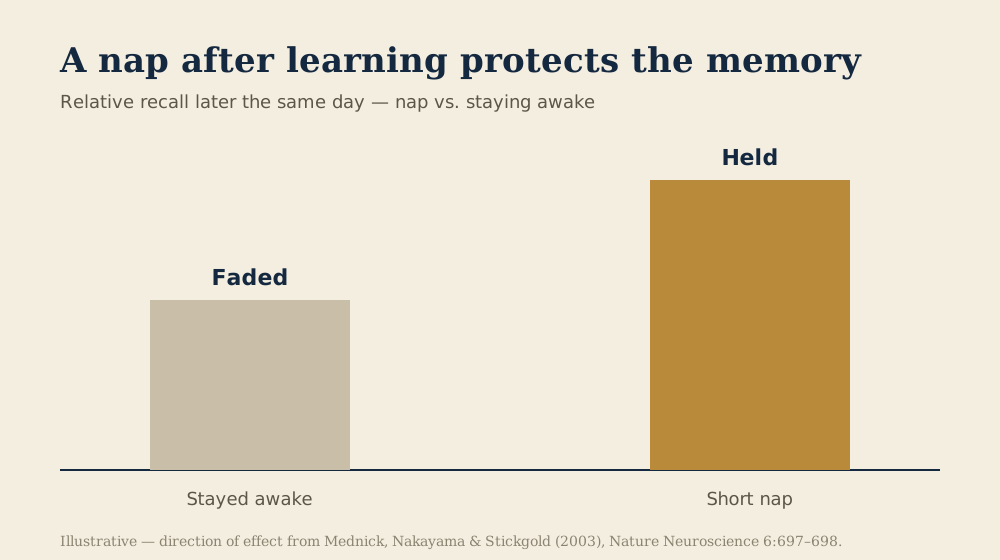
There’s a study I keep coming back to because the title says it all: “a nap is as good as a night.” Researchers had people practice a perceptual task, then some napped and some stayed awake. Later that same day, the awake group had gotten worse: their performance decayed across the day. The nappers hadn’t just held steady; a nap with both deep and REM sleep restored the skill about as much as a full night would.[1]
That’s the part that flipped it for me. Staying awake wasn’t neutral. It was actively eroding what I’d just learned, hour by hour, while I congratulated myself for grinding.
Figure 1
A nap is as good as a night
Stayed awake
- Practised a perceptual task
- Performance decayed across the day
- Worse by the evening than after practice
Napped
- Practised the same task
- A nap with deep and REM sleep restored the skill
- About as much as a full night would
Why sleep is where the memory actually sets
The reason is buried in what your brain does off the clock. As the sleep researcher Daniel Erlacher describes it, memory consolidation during sleep is one of the most solidly established functions we have: material learned before a sleep period is kept better than the same material learned before an equal stretch of just being awake.[2] Deep, slow-wave sleep in particular seems tied to locking in the facts-and-events kind of memory.
So when you nap after learning, you’re not resting the muscle. You’re running the save process. The wakeful hours are for taking things in. The sleep is for deciding what’s worth keeping and filing it somewhere it won’t evaporate by dinner.
The nap that works, and the one that wrecks your night
This is where most people, me included, get it wrong. There are two very different naps, and only one of them helps.
The short one. Roughly 20 minutes, taken soon after learning. Even short naps have helped recall in some studies[3], but the “as good as a night” result came from 60–90-minute naps containing deep and REM sleep. The short version is the low-risk one: you don’t sink into the deepest sleep and wake up foggy. You come out a little soft for a minute, then clearer than before.
The long, late one. Ninety minutes at 6pm feels amazing and then quietly steals your night: you’re not tired at bedtime, your whole schedule drifts, and the fix becomes the problem. If you want the longer nap for its REM (useful for skill-type learning), take it early in the afternoon, not as the sun’s going down.
Figure 2
The short nap and the long one
A short nap
- Taken soon after learning
- You don't sink into the deepest sleep and wake up foggy
- Short naps helped recall in some studies
A long nap
- Contains deep and REM sleep, like the as-good-as-a-night result
- Take it early in the afternoon
- Taken late, it steals your night
The other quiet wrecker is light and noise. A nap in a bright, half-lit room is a shallow, twitchy nap: you never really drop in, so the consolidation barely happens. The single cheapest fix I found was just making it properly dark.

Disclosure: Amazon affiliate link · I only point at gear I actually use.
How to nap after learning, on purpose
You can engineer this instead of hoping you happen to get sleepy.
Learn the hard thing first. The nap only has something to consolidate if you’ve genuinely loaded the material. Do the real work, then lie down.
Keep it to about 20 minutes, early (or a full 60–90 minutes if your afternoon allows). Set an alarm. Make the room dark. If you drift off, great; if you just lie there in the quiet, that light drowsy rest still helps more than pushing on.
Don’t rescue it with caffeine you took too late. A nap and a jittery half-sleep are not the same. If you’re wired, you’ll get the shallow version that doesn’t consolidate. Same reason a cool, quiet room beats a warm bright one even for twenty minutes.
The thing nobody tells you
The nap is a multiplier, not a substitute. It protects what you learned. It can’t save a night of bad sleep or hours of half-focused reading. But paired with real study, it’s one of the highest-return twenty minutes there is. You already did the hard part. Lying down afterward isn’t quitting. It’s the save button.
[1] Mednick S., Nakayama K. & Stickgold R. (2003). “Sleep-dependent learning: a nap is as good as a night.” Nature Neuroscience, 6(7), 697–698.
[2] Erlacher, D. (2019). Sport und Schlaf. Springer.
[3] Lahl, O. et al. (2008). “An ultra short episode of sleep is sufficient to promote declarative memory performance.” Journal of Sleep Research, 17(1), 3–10.
The nap is one lever. The Deep Sleep Guide puts the core levers in one plan (light, rhythm, wind-down, bedroom), plus what to do when you lie awake at night and a printable sleep log. 16 pages, €4,99.
GET THE GUIDE →Tools we rate for this. Some are affiliate links, so we may earn a small commission if you buy through them, at no extra cost to you.
Comments
0 comments