
How to fix your sleep schedule in 3 days
You know the spiral. One late night, then 3am scrolling, then you’re lying there at 1am wide awake and furious at yourself, and somehow it’s been like this for two weeks.
Here’s the reframe that fixed it for me: it’s not willpower. How to fix your sleep schedule in 3 days isn’t about trying harder to fall asleep. It’s about pointing your internal clock the right way again. And the clock runs almost entirely on light.
How to fix your sleep schedule in 3 days
Moving your clock earlier is the hard direction: with strong morning light it can move roughly 30–40 minutes a day.[2] So you don’t yank bedtime back four hours in one night. That never works. You walk it back about an hour per night for three nights, and you anchor each morning with bright light.
Researchers showed how strong the light signal is: after a week of camping with only natural light, people’s internal night moved earlier and lined up with sunset, most of all in the latest sleepers.[1] You don’t need a tent. You need to copy the signal.
The 3-day protocol
The anchor: morning light. Soon after waking, get outdoor light for as long as you can. The studies that shifted the clock used hours of bright morning light. It’s the strongest lever you have; it tells your clock “morning is now” and sets the timing of tonight’s sleepiness. Do it even on day one when you’re exhausted, especially then.
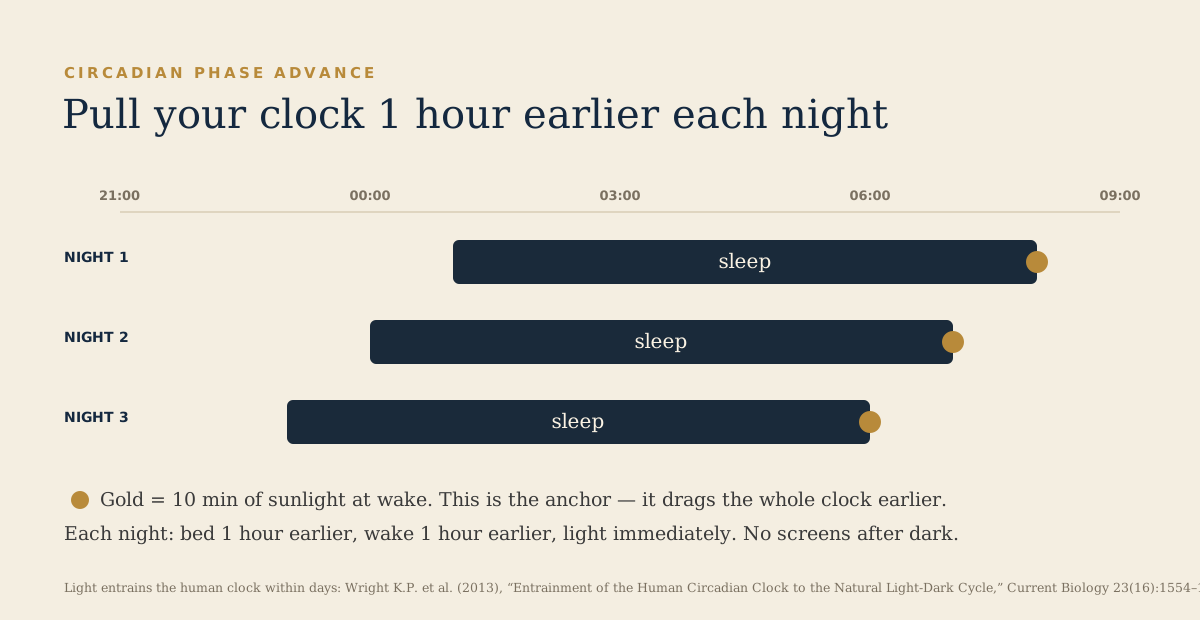
The shift: one hour per night. Night 1, go to bed one hour earlier than your current drift. Night 2, another hour. Night 3, one more. Wake at the matching earlier time each day (alarm, no snooze) and hit the light immediately. Three earlier nights plus bright mornings typically recover one to two hours, not three, but enough to feel the difference.
Figure 1
The three-day reset
- Every morningWake at the earlier time, no snooze, outdoor light straight away.
- First nightBed one hour earlier than your current drift.
- Second nightAnother hour earlier.
- Third nightOne more.
- Every eveningNo bright screens late; a cool, dark room.
The evening: protect the runway. No bright screens in the last 90 minutes: that light tells your clock it’s still daytime and undoes the morning’s work. Cool, dark room. Magnesium bisglycinate showed a small benefit for self-rated insomnia in one trial. It’s optional, not part of the reset.
A wake-up light helps on the dark mornings: it fakes a sunrise. In a small study this boosted the cortisol rise after waking, which can make early alarms easier.

Disclosure: Amazon affiliate link · I only recommend gear I actually use.
Three days gets the clock pointing the right way. Keeping it there is the rest of the system: room temperature, the last 90 minutes, and a few things people never think about.
[1] Wright K.P. et al. (2013). “Entrainment of the Human Circadian Clock to the Natural Light-Dark Cycle.” Current Biology, 23(16), 1554–1558.
[2] Burgess H.J. et al. (2003). “Preflight adjustment to eastward travel: 3 days of advancing sleep with and without morning bright light.” Journal of Biological Rhythms, 18(4), 318–328.
A schedule reset works best when the basics are in place. The Deep Sleep Guide puts the core levers in one plan (light, rhythm, wind-down, bedroom), plus what to do when you lie awake at night and a printable sleep log. 16 pages, €4,99.
GET THE GUIDE →Tools we rate for this. Some are affiliate links, so we may earn a small commission if you buy through them, at no extra cost to you.
Comments
0 comments