
How many days does it take to adjust to jet lag?
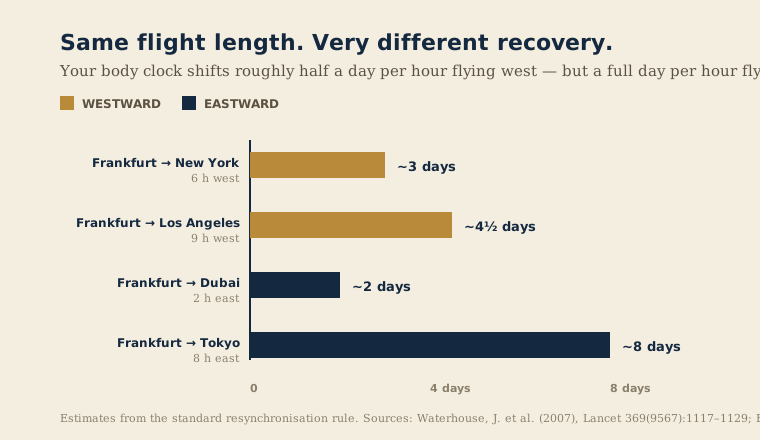
I came back from a trip east once (eight time zones, the kind of flight where you land and your body has genuinely no idea what has happened to it), and I gave myself two days. Two days, and then a full week of real work in the calendar.
It went badly. Not dramatically badly. Just a fog that wouldn’t lift, for what felt like forever, while I kept telling myself I was nearly over it.
So this is the thing I actually wanted to know before the next one: how many days does it take to adjust to jet lag, honestly? Not the in-flight-magazine version. A number you can put in a calendar. And there is one. It’s just far less generous in one direction than the other.
How many days does it take to adjust to jet lag? The rule of thumb
The estimate researchers actually work with is almost insultingly simple.
Flying west, your body clock shifts about 1.5 hours a day, roughly two-thirds of a day for every hour of time difference. Flying east, it shifts about an hour a day, so roughly a full day per hour.[4]
So Frankfurt to New York, six hours west: about four days. Frankfurt to Tokyo, seven to eight hours east depending on the season: about seven to eight days.
Figure 1
How far your clock shifts in a day
- ~1.5 hoursa day, flying west
- About an houra day, flying east
Up to eight days. I had booked myself two.
And this isn’t some rough gym-bro heuristic; it falls straight out of how the clock works. Your body doesn’t know it has flown anywhere. It arrives still keeping the time of the place you left, and then the light and the mealtimes and the noise of the new place start slowly dragging it round, an hour or so at a time.[1] Nothing about that process cares how motivated you are.
Why east costs you more
Here’s the bit that finally made it click for me. Left completely alone in a bunker with no daylight, the human clock doesn’t run at exactly twenty-four hours. It runs slightly long.
Which means stretching your day is the direction your body already leans. Flying west, you stay up later. That’s the easy way. Flying east, you have to compress: go to bed when your body thinks it’s late afternoon, get up when it thinks it’s the middle of the night. You’re shoving the clock uphill.
Same number of hours. About half as many days again.
Although (and Erlacher is careful about this, which I appreciated) the evidence isn’t perfectly clean. Other things ride along with direction. Whether you’re at the start of a trip or coming home matters, because home has a fixed schedule waiting and a holiday doesn’t.[2] The rule is a planning tool, not a law of physics.
The NBA accidentally ran the experiment on 11,481 games
What convinced me wasn’t a lab, though. It was basketball.
A team at Monash went through ten seasons of NBA data (eleven and a half thousand games) and sorted every one of them by whether the team had recently travelled east, west, or not across time zones at all.[3]
Eastward travel showed up. Westward didn’t. Teams playing at home after an eastward shift had a worse points differential, grabbed fewer rebounds, shot less efficiently. And the bigger the shift, the worse it got: a two-hour eastward jump was associated with something like four and a half points of differential, gone.[3]
These are professional athletes with sleep coaches and chartered flights and every recovery resource money can buy. They still couldn’t out-discipline the direction of travel. That reframed the whole thing for me, honestly. I’d been treating jet lag as a willpower problem.
What actually moves the clock
Only one thing really shifts your body clock at any speed, and it isn’t sleep. It’s light. Everything else (meals, exercise, when you go to bed) nudges. Light shoves.
The rough version: flying east, chase morning light and hide from bright light late in the evening. Flying west, do the opposite: get light in the evening, go easy on it first thing. It’s the same mechanism I went down the rabbit hole on in the piece about what morning sunlight does to your cortisol curve, just aimed at a different problem.
One honest caveat, because this trips people up: after really big jumps (eight, ten, twelve zones), the light that feels like morning light might land at the wrong point in your internal day and push your clock the wrong way. On the big ones, sunglasses for the first morning or two is genuinely a strategy, not paranoia.
Which is fine in July. It’s a lot less fine landing in northern Europe in November, when the sun comes up somewhere around the time your first meeting starts.

Disclosure: Amazon affiliate link · I only point at the category I’d actually buy from.
Half of what you’re feeling isn’t jet lag at all
And this is the distinction almost nobody makes, which I think is why the advice out there is such a mess.
Erlacher separates two things that arrive on the same plane. There’s jet lag: your clock sitting in the wrong time zone, which takes days. And there’s travel fatigue: the dehydration, the eleven hours folded into a seat, the airport stress, the bad food. That second one has nothing whatsoever to do with time zones. You get it flying north to south, where the clock never moves at all.[2]
Travel fatigue clears in a day or two with water, food and a real night’s sleep. Jet lag doesn’t care about any of that and takes as long as it takes.
Figure 2
Jet lag vs. travel fatigue
Jet lag
- Your clock sitting in the wrong time zone
- Takes days
- Light is what really shifts it
Travel fatigue
- Dehydration, hours folded into a seat, airport stress
- Happens flying north to south too
- Clears in a day or two with water, food and a real night's sleep
There’s a third one hiding in there too, and it’s my favourite because it’s so ordinary: the first-night effect. Your first night in an unfamiliar room is measurably worse (more waking, harder to drop back off), simply because it’s unfamiliar.[2] Not the time zone. The room.
So that terrible first night you were about to blame on an eight-hour shift? Some of it was just a strange ceiling.
The reason this matters practically: if you don’t know which one you have, you can’t tell whether you’re nearly through it or three days in on a nine-day job.
The one supplement with actual evidence behind it
I’m generally sceptical here. I’ve taken enough things that did nothing. But melatonin for jet lag is one of the few interventions that keeps turning up in the serious reviews rather than just the blogs.[1]
The part people get wrong: it isn’t a sleeping pill. It’s a timing signal, a chemical way of telling your clock which way night is. Which is why the hour you take it matters far more than the dose, and why a big dose at the wrong time can shove you further from where you want to be. Low doses (0.5–1 mg) are often enough; avoid more than 5 mg. Supplements aren’t FDA-regulated, so the label may be off, and they may interact with medication. Ask a doctor if you take any or are pregnant.[4]

Disclosure: affiliate link (WeightWorld via AWIN) · not medical advice.
The thing nobody tells you
The number was never the problem. The problem was that I’d decided in advance what the number should be, and then interpreted every foggy afternoon as evidence I was nearly through.
Do the arithmetic before you book instead. Hours of shift: about two-thirds of a day each going west, a full day each going east. Then put the important thing after that, not on day two. If the trip is short enough (a two-day hop east), the honest move is often not to adapt at all: stay on home time, keep your own hours, come back before your clock has committed to anything.
And when you land back, don’t improvise the recovery. Anchor it (fixed wake time, light in the morning, no heroic lie-ins), which is the same three-day reset I wrote about for a schedule that’s drifted.
Two-thirds of a day per hour west. A full day per hour east. Embarrassingly simple. Almost insulting.
[1] Waterhouse, J., Reilly, T., Atkinson, G. & Edwards, B. (2007). “Jet lag: trends and coping strategies.” The Lancet, 369(9567), 1117–1129.
[2] Erlacher, D. (2019). Sport und Schlaf. Springer.
[3] Leota, J., Hoffman, D., Czeisler, M. É. et al. (2022). “Eastward jet lag is associated with impaired performance and game outcome in the National Basketball Association.” Frontiers in Physiology, 13, 892681.
[4] Centers for Disease Control and Prevention. CDC Yellow Book: “Jet Lag Disorder.”
Jet lag is your body clock in the wrong place; a steady rhythm at home makes every trip easier. The Deep Sleep Guide puts the core levers in one plan (light, rhythm, wind-down, bedroom), plus what to do when you lie awake at night and a printable sleep log. 16 pages, €4,99.
GET THE GUIDE →Tools we rate for this. Some are affiliate links, so we may earn a small commission if you buy through them, at no extra cost to you.
Comments
0 comments