
Why is flying east worse than flying west?
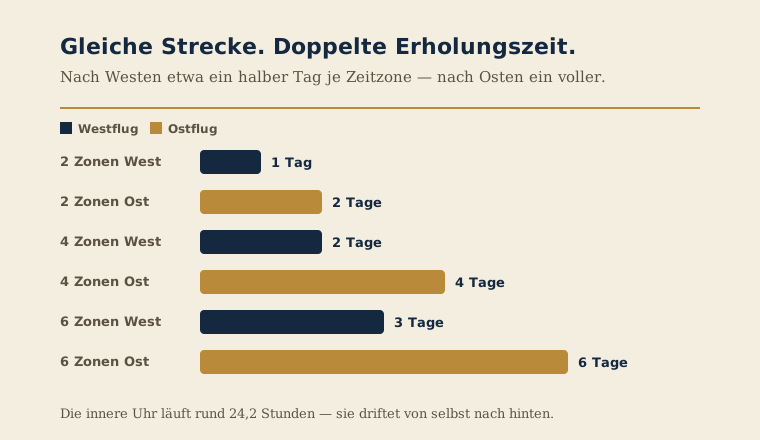
Same six time zones. Same flight length. One direction leaves you functional by Wednesday, the other has you staring at the ceiling at 4am for a week.
It is not in your head, and it is not about the flight. It comes down to one small fact about your internal clock, and once you know it, the fix stops being guesswork.
Your clock runs long
Left in constant dim light with no clues about time, the human body clock does not hold at 24 hours. It drifts, and it drifts slow: most people run a cycle of roughly 24.2 hours.
That twelve-minute surplus is why you naturally drift later, not earlier. Staying up late is easy. Falling asleep two hours early is nearly impossible, whatever your intentions were.
Every morning, light resets that drift back to 24. But the underlying tendency never goes away, and it decides everything about jet lag.
Which is why direction matters so much
Flying west means your day gets longer. You land, it is earlier than your body thinks, you stay up a bit later. That is the direction your clock already wants to go. You are pushing a door that opens.
Flying east means your day gets shorter. You land, it is later than your body thinks, and you have to fall asleep and wake up earlier than your body is prepared to. You are pulling against the drift, every day, until you win.
The practical rule that falls out of this:
- West: roughly two-thirds of a day of adjustment per time zone crossed (the clock shifts about 1.5 hours a day).
- East: roughly a full day per time zone.
Six zones west, about four days. Six zones east, about six. Same trip, half as long again, entirely because of which way the clock has to move.
Figure 1
Flying west vs. flying east
West: the day gets longer
- Goes with your clock's natural drift later
- Staying up a bit later is easy
- Roughly two-thirds of a day per time zone
East: the day gets shorter
- Pulls against the drift, every day
- You must sleep and wake earlier than your body wants
- Roughly a full day per time zone
Twenty years of baseball made the case
The problem with jet lag research is that you cannot run it properly. Nobody will fly a few hundred people back and forth for years while you measure them.
Professional sport did it anyway, by accident. Researchers took twenty seasons of Major League Baseball (1992 to 2011), where teams cross time zones constantly in both directions, and every action is recorded in absurd detail. [1]
The effects they found were not vague tiredness. They were specific and lopsided: measurable performance changes after eastward travel that did not appear the same way going west. The most quoted example is pitchers giving up more home runs after flying east.
And here is the part most articles leave out. Other researchers published a formal objection in the same journal, arguing that the analysis shows correlation, not proof of cause. [2]
I think the objection is fair and the finding still stands as suggestive. The direction effect is well established from laboratory work on the body clock; the baseball data is consistent with it, not proof of it. That distinction is worth keeping.
What actually helps, split by direction
Because the mechanism is light, the fix is light, and it is the opposite prescription depending on which way you flew.
Flying east (the hard one)
- Morning light at the destination. Get outside early. Morning light pulls your clock earlier, which is exactly the direction you need.
- Avoid bright evening light. It pushes you later, the wrong way.
- Start before you fly. Shift bedtime about an hour earlier for three nights beforehand and get bright light right after waking. That can pre-shift your clock by up to about two hours.
Flying west (the easy one)
- Evening light. Stay up in bright surroundings; that is the direction your clock already drifts.
- Do not nap on arrival if it is still daylight. Push through to a local bedtime.
- Usually needs no preparation. Your body does most of it for you.
Figure 2
The light prescription flips with direction
Flying east
- Morning light at the destination
- Avoid bright evening light
- Shift bedtime earlier for a few nights before you fly
Flying west
- Evening light: stay up in bright surroundings
- No nap on arrival while it is still daylight
- Usually no preparation needed
The trap: getting the light backwards
This is where people accidentally make it worse. Flying east and sitting in a bright hotel bar until midnight pushes your clock further in the wrong direction. You land and then actively fight your own adjustment.
There is one genuine complication. Cross enough time zones east (around eight or more) and morning light at the destination can hit the part of your cycle that pushes you later instead of earlier. Your body then adapts the long way round, westward, and the simple rule breaks down.
For those trips a proper light schedule is worth the effort. For the ordinary three to six zones, the rule above holds.
The short version
Your clock drifts late by about twelve minutes a day. West goes with the drift; east fights it. That is the entire asymmetry, and every practical piece of advice follows from it: flying east, chase the morning light. Flying west, stay up in the evening light.
If you want the recovery arithmetic for your specific trip, that is in the companion piece on how many days it takes to adjust to jet lag.
[1] Song, A., Severini, T. & Allada, R. (2017). “How jet lag impairs Major League Baseball performance.” PNAS, 114(6), 1407–1412.
[2] Formal comment: “Baseball and jet lag: correlation does not imply causation.” PNAS, 114(16), E3168.
Light timing is the lever for jet lag, and for every ordinary week too. The Deep Sleep Guide puts the core levers in one plan (light, rhythm, wind-down, bedroom), plus what to do when you lie awake at night and a printable sleep log. 16 pages, €4,99.
GET THE GUIDE →Tools we rate for this. Some are affiliate links, so we may earn a small commission if you buy through them, at no extra cost to you.
Comments
0 comments