
What is a good HRV, and can you improve it?
The first week I owned a ring I checked my HRV before I checked the weather. 34 one morning, 71 the next, and I spent both days constructing theories about why.
Neither number meant what I thought. It took embarrassingly long to work out that I was reading a thermometer as if it were a grade.
What the number is
Your heart does not beat like a metronome. The gap between beats varies constantly: slightly longer, slightly shorter. HRV measures that variation, usually in milliseconds.
Counterintuitively, more variation is the healthy direction. A rigid, metronomic heart rate means one system is dominating. A variable one means the two branches of your autonomic nervous system are both active and negotiating, which is what a well-regulated body looks like.
Most consumer devices report RMSSD, which tracks the parasympathetic side fairly well. Different metrics produce wildly different numbers for the same heart, which is the first reason cross-device comparison is meaningless. [1]
So what’s a good number?
There isn’t one, and this is the part the apps handle badly.
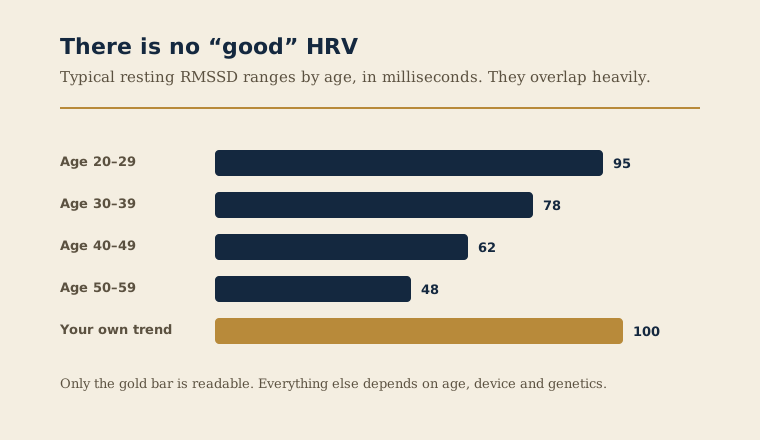
Short-term norms for healthy adults put RMSSD around 42 ms on average, roughly 19–75 ms, and overnight wearable readings often run higher. [1] A 25-year-old athlete might sit at 90; a healthy 55-year-old might sit at 30. Both are fine. The distributions for different ages overlap so heavily that knowing someone’s HRV tells you very little about their health without knowing them.
Figure 1
No single good number
- ~42 msaverage short-term RMSSD
- 19–75 msroughly the normal range
Three things move it that have nothing to do with how well you are doing:
- Age. HRV declines steadily from the twenties. This is normal and not reversible by effort.
- Genetics. A large share of the between-person difference is simply inherited.
- Measurement conditions. Position, time of night, device, and which algorithm the manufacturer used this firmware version.
Which leaves one legitimate comparison: you against you, same device, over weeks. Everything else is noise dressed as insight.
Reading the trend instead of the number
Take a fortnight of morning readings and you get a personal range. What matters afterwards is where today sits relative to that range, and which direction the average is drifting.
A single low morning means almost nothing: day-to-day swings of 20–30% are ordinary in healthy people. Three or four consecutive days meaningfully below your own range is worth attention. A downward drift across three weeks is a real signal.
Figure 2
When a low reading matters
- One low morningAlmost nothing. Day-to-day swings are ordinary.
- Several days lowThree or four days below your own range: worth attention.
- A drift over weeksYour average sliding down across three weeks is a real signal.
This is why the daily readiness score irritates me. It converts a noisy measurement into a confident verdict, and people plan their training around the noise.
What actually moves it
Alcohol: the largest single-night effect
Two drinks will visibly suppress HRV that night and often the following one. If you want proof the metric is measuring something real, this is the cheapest experiment available: it shows up unmistakably, every time, in almost everyone.
Sleep
Short nights lower it. Irregular schedules may too.
Aerobic fitness: the only durable lever
Consistent aerobic training raises resting HRV over months. Nothing else produces a comparable lasting change. Note the timescale: months, not a week of good behaviour.
Training load
A hard session suppresses HRV for a day or two. That is the correct response, not a warning. The concerning pattern is suppression that does not recover across a week.
Slow breathing
Around six breaths a minute raises HRV dramatically during the practice. Whether daily practice raises your resting value is less certain than the marketing suggests, but the acute effect is real and free.
What doesn’t move it
Most supplements marketed for recovery. Cold plunges produce a short spike that says little about baseline. And “HRV training” apps mostly measure your compliance with slow breathing while you breathe slowly.
How I’d use it now
- Same device, same time, same position. Morning, lying down.
- Ignore single days entirely.
- Watch the weekly average, not the daily score.
- Use it to catch accumulating load (poor sleep, drinking, stress stacking up), not to decide today’s workout.
- Never compare your number to anyone else’s.
Used that way it is genuinely informative: an early warning that you are spending more than you are recovering, usually a few days before you would have noticed on your own. Used as a daily grade, it mostly generates anxiety, which is itself bad for HRV.
Why two devices disagree about the same night
People discover this when they wear a ring and a chest strap together and get numbers 30% apart. Neither is broken.
Chest straps read the heart’s electrical signal directly. Wrist and finger devices read blood volume changes optically, which is a step removed and more affected by movement, skin tone and how tightly the thing is worn. On top of that, every manufacturer applies its own filtering and averaging, and they do not publish the details.
The consequence is simple and worth taking seriously: your HRV history belongs to your device. Switch devices and you start a new baseline, with no way to compare across the change.
The morning-reading trap
Devices that measure through the night usually report an average across your deepest stretch, which is reasonably stable. Devices that ask for a morning spot-check are far noisier: that reading is sensitive to whether you sat up, whether you had already thought about your day, and how long you had been awake.
If you use spot checks, standardise ruthlessly: same posture, before getting out of bed, before looking at your phone, for the same duration. Otherwise you are measuring your morning routine.
What a genuinely useful drop looks like
The pattern worth acting on is not one bad number. It is your weekly average sitting clearly below the previous fortnight while nothing obvious explains it: no hard training block, no illness, no travel.
That combination is the early signal of accumulating load, and it typically shows up a few days before you consciously feel run down. Catching that is the entire practical value of the metric.
The corresponding non-signal: a low morning after a late meal, a hard session, a glass of wine, or a bad night. Those are your body responding correctly to something you did. Nothing to act on.
Should you buy a device for this?
If you are training seriously and want an objective check on recovery, yes. Used as a weekly trend it adds something you cannot get by feel.
If you are hoping it will tell you whether you are healthy, no. It will hand you a number with no reference range that means anything for you personally, attach a confident daily verdict to it, and give you something new to worry about at 7am. For a lot of people that is a net loss, and the irony writes itself.
[1] Shaffer, F. & Ginsberg, J. P. (2017). “An overview of heart rate variability metrics and norms.” Frontiers in Public Health, 5, 258.
HRV is downstream of sleep, alcohol, light and training load. The Deep Sleep Guide puts the core levers in one plan (light, rhythm, wind-down, bedroom), plus what to do when you lie awake at night and a printable sleep log. 16 pages, €4,99.
GET THE GUIDE →Tools we rate for this. Some are affiliate links, so we may earn a small commission if you buy through them, at no extra cost to you.
Comments
0 comments