
5 mistakes quietly ruining your deep sleep
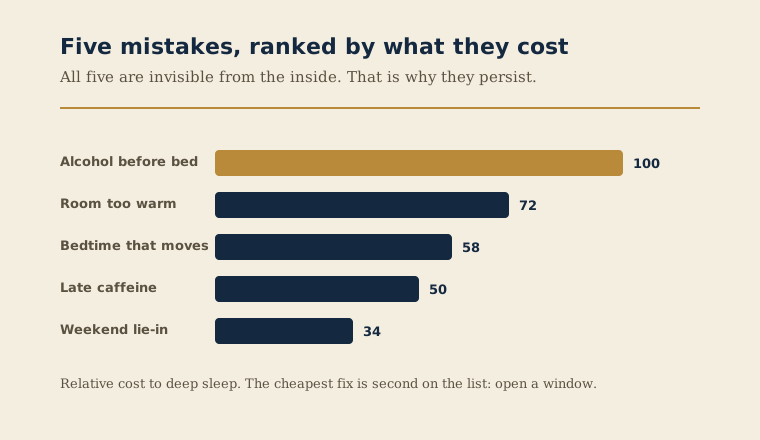
You can sleep eight hours and still wake up feeling like you didn’t. Duration is the number everyone tracks; depth is the thing that does the repair.
Deep slow-wave sleep is when growth hormone is released, when (according to animal studies, though recent work disputes it) the brain’s waste clearance may be most active, and when the day’s learning gets transferred into long-term storage. It is concentrated in the first half of the night, and it is easy to damage without noticing, because you never see it happen.
These are the five that cost the most, roughly in order.
1. The nightcap
Alcohol is the most common sleep wrecker, not because it removes deep sleep (it can even add some early on), but because it fragments the second half of the night and cuts REM. It disguises itself as a sleep aid because it does genuinely shorten the time it takes to fall asleep.
What follows is the problem. As blood alcohol falls in the second half of the night, sleep fragments badly: more awakenings, suppressed REM, and a rebound that leaves the night’s architecture in pieces. [1] You spent the first half unconscious quickly and the second half barely sleeping.
Figure 1
The nightcap's two halves
First half of the night
- You fall asleep faster
- It can even add some deep sleep early on
- It feels like a sleep aid
Second half of the night
- Blood alcohol falls and sleep fragments
- More awakenings, suppressed REM
- A rebound that leaves the night in pieces
The fix that is actually achievable: finish drinking three to four hours before bed. Most of the fragmentation comes from metabolising alcohol while asleep. Finishing earlier helps after one or two drinks; with more, alcohol is still in your system at bedtime.
2. A room that’s too warm
Your core temperature has to drop to enter and hold deep sleep. A warm room blocks the drop, and the result is not usually “can’t sleep”. It is shallower sleep you never register as shallow.
A cool room suits most people. Roughly 16–19 °C (60–67 °F) is the range usually recommended, though the exact figure matters less than the direction. Cool room, warm feet: a hot bath 90 minutes before bed works for the same reason, by driving blood to the skin so heat leaves faster afterwards.
This is the cheapest item on the list. It costs opening a window.
3. A bedtime that moves
Sleep is scheduled, not summoned. Your body prepares for it based on when you usually go to bed, and an irregular schedule is linked to worse sleep overall.
An hour of drift is tolerable. Three hours between weekdays and weekends means your body is repeatedly preparing for a night that arrives at the wrong time: social jet lag, without the flight.
Anchor the wake time first. It is the stronger signal, and it is the one you can actually control with an alarm.
4. Caffeine you’ve stopped noticing
Covered in detail elsewhere, but it belongs on this list because of one specific finding: caffeine reduces slow-wave sleep even when it does not stop you falling asleep. You will sleep. You will sleep more lightly, and you will not be able to tell.
About nine hours before bed for a regular coffee, longer for bigger doses, according to a 2023 meta-analysis. [2] If that seems excessive, that is the half-life talking.
5. Catching up at the weekend
The Saturday lie-in feels like repayment. Physiologically it is mostly a second clock shift: you push your body clock later, then force it back on Sunday night, and Monday morning arrives with the effects of a small time-zone change.
Extra sleep after a short week does help; the sleepiness genuinely lifts. What it does not do is undo the metabolic cost of the short nights, and the timing shift adds a new problem on top.
Better: an extra hour, not three, and take it at the front of the night by going to bed earlier, rather than at the back by getting up later.
The pattern behind all five
Every one of these is invisible from the inside. You do not feel your deep sleep being suppressed; you feel fine at 11pm and unaccountably flat on Wednesday. That is exactly why they persist: there is no feedback signal, so nothing corrects the behaviour.
If you fix one, fix the room temperature: it is free, it takes a night to notice, and it needs no willpower at all. If you fix two, move the drinking earlier.
The honourable mentions
Late heavy meals. Digestion raises core temperature at exactly the moment it needs to fall. Some people sleep worse after a large late meal, so leave a couple of hours if you can. A light snack is fine.
Screens, but not for the reason usually given. The light does suppress melatonin somewhat. The bigger effect is that the content keeps you engaged and pushes bedtime later. Blue-light glasses do nothing about the second problem, which is the one costing you the sleep.
Hard training too late. Intense exercise raises core temperature and arousal for a few hours afterwards. Within an hour of bed it is a problem; three hours before, the evidence is much weaker than the folklore.
Things blamed unfairly
Waking in the night. Brief awakenings are normal. Healthy sleepers have several and forget most of them. Waking is not evidence of ruined sleep. Lying awake for an hour is a different matter.
Dreaming a lot. Remembering dreams mostly means you woke close to REM. It says nothing about quality.
Your tracker’s deep sleep percentage. Wrist devices estimate stages from movement and heart rate, and they are substantially less accurate for deep sleep than for total sleep time. Use the trend; do not optimise the number.
The order I’d actually fix them in
- Room temperature. Free, one night to test, needs no willpower.
- A fixed wake time. Costs nothing, works within about a week, fixes the schedule problem from the stronger end.
- Caffeine cut-off. Requires one decision made once, in the afternoon.
- Move drinking earlier. Achievable in a way that “stop drinking” usually is not.
- Weekend timing. Last, because it is the smallest of the five and the hardest to give up.
Figure 2
The order to fix them in
- Room temperatureFree, one night to test, no willpower needed.
- A fixed wake timeCosts nothing, works within about a week.
- Caffeine cut-offOne decision, made once, in the afternoon.
- Drink earlierAchievable in a way that stopping usually is not.
- Weekend timingLast: the smallest of the five.
Doing the first two costs nothing and no effort, and between them they cover the two mechanisms (temperature and timing) that most directly gate deep sleep. Start there rather than with the supplement aisle.
[1] Ebrahim, I. O. et al. (2013). “Alcohol and sleep I: effects on normal sleep.” Alcoholism: Clinical and Experimental Research, 37(4), 539–549.
[2] Gardiner, C. et al. (2023). “The effect of caffeine on subsequent sleep: a systematic review and meta-analysis.” Sleep Medicine Reviews, 69, 101764.
Fixing these five is a start. The Deep Sleep Guide puts the core levers in one plan (light, rhythm, wind-down, bedroom), plus what to do when you lie awake at night and a printable sleep log. 16 pages, €4,99.
GET THE GUIDE →Tools we rate for this. Some are affiliate links, so we may earn a small commission if you buy through them, at no extra cost to you.
Comments
0 comments