
Does blue light before bed really ruin your sleep?
Blue light has become the villain of evening routines, and the fix is always the same: a filter, an app, a pair of orange glasses. The framing is not wrong exactly, but it points at the smallest lever in the room.
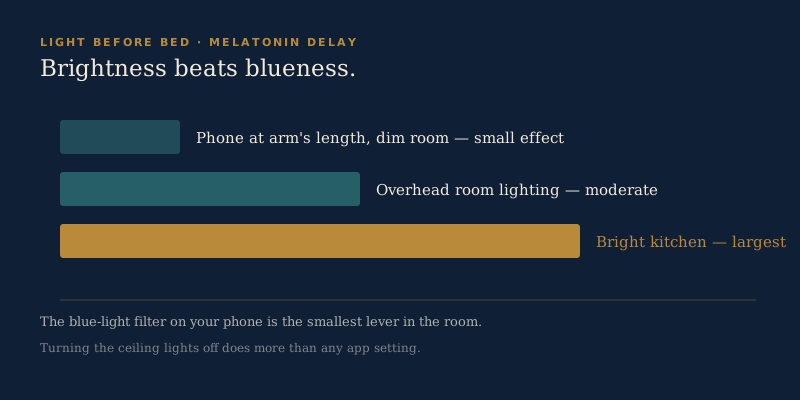
What suppresses melatonin is light. Blue wavelengths are more potent per unit (that part is real), but total brightness and how long you are exposed matter more than the colour. A bright white ceiling light at eleven at night does more than a dimmed phone at arm's length.
Why the phone gets blamed
Because it is close to your face and it is the thing you are holding when you notice you cannot sleep. But a screen at arm's length in an otherwise dim room delivers a fraction of the light your kitchen ceiling delivers when you go to get a glass of water.
The correlation people notice is real, and screens can contribute: in one study, four hours of e-reader use before bed suppressed melatonin and delayed the body clock compared with a printed book. [1] For most people, though, room light and staying engaged matter even more: being on the phone keeps you awake, alert and horizontal at midnight.
What actually moves the needle
Dim the room, not the screen. One or two warm lamps instead of overhead lighting for the last hour changes total exposure far more than any filter setting. If you only do one thing, this is it.
And the direction that matters more than either: light in the morning. Getting bright light early anchors the whole rhythm: morning daylight, ideally outdoors, is the main signal your clock uses. [2] Evening light control is damage limitation; morning light is the actual lever.
Figure 1
Brightness beats blueness
The smaller levers
- The blue colour of the light
- Screen filters and orange glasses
- Evening light control on its own
The bigger levers
- Total brightness and how long you're exposed
- One or two warm lamps instead of ceiling lights
- Bright light in the morning
Where filters do help
If your work genuinely requires a bright screen late, a filter plus reduced brightness is better than nothing. It is a small effect, but small and free is still worth having.
The thing not to do is buy the glasses, keep every light in the flat on, and wonder why nothing changed.
The one-sentence version
Blueness is a smaller lever than brightness, and evening light is a smaller lever than morning light, so turn the ceiling lights off, and go outside when you get up.
[1] Chang, A.-M. et al. (2015). “Evening use of light-emitting eReaders negatively affects sleep, circadian timing, and next-morning alertness.” PNAS, 112(4), 1232–1237.
[2] Wright, K. P. et al. (2013). “Entrainment of the human circadian clock to the natural light-dark cycle.” Current Biology, 23(16), 1554–1558.
Cutting evening light is one step of a good wind-down. The Deep Sleep Guide puts the core levers in one plan (light, rhythm, wind-down, bedroom), plus what to do when you lie awake at night and a printable sleep log. 16 pages, €4,99.
GET THE GUIDE →Tools we rate for this. Some are affiliate links, so we may earn a small commission if you buy through them, at no extra cost to you.
Comments
0 comments