
Can you train your brain to need less sleep?
I went through a whole phase, a few years back, where I was quietly proud of running on five hours. I’d tell people I’d ‘trained myself’ down to it, like it was a skill, like a cold shower or a second language. And for a while it genuinely felt true. I got up, I functioned, nobody died.
So this is the question I actually needed answered, honestly: can you train your brain to need less sleep, or were those months just… me slowly getting worse without noticing? I’m not going to be coy about it. It was the second one. And the science of why I couldn’t tell is the genuinely unsettling part.
Can you train your brain to need less sleep? The short, annoying answer
No. Or, more precisely (and this is the bit that gets everyone), you can train yourself to tolerate less sleep. You cannot train your brain to need less of it. Those are two completely different things, and the gap between them is exactly where the whole myth lives.
Your sleep need is mostly set. It varies a lot from person to person (some adults really do fine on six and a half hours, others need nine), but the amount your brain wants is close to fixed. It’s not a muscle you shrink with discipline. What you can get very good at is ignoring the alarm bell. Which is a different skill, and a worse one.
The study that settles it
There’s one experiment I keep coming back to because it’s almost cruelly clean. Van Dongen and his colleagues put healthy adults on a strict sleep diet for two full weeks: one group got four hours a night, one got six, one got a proper eight. Every couple of hours during the day they measured attention with a dead-simple reaction test: a light appears, you tap.
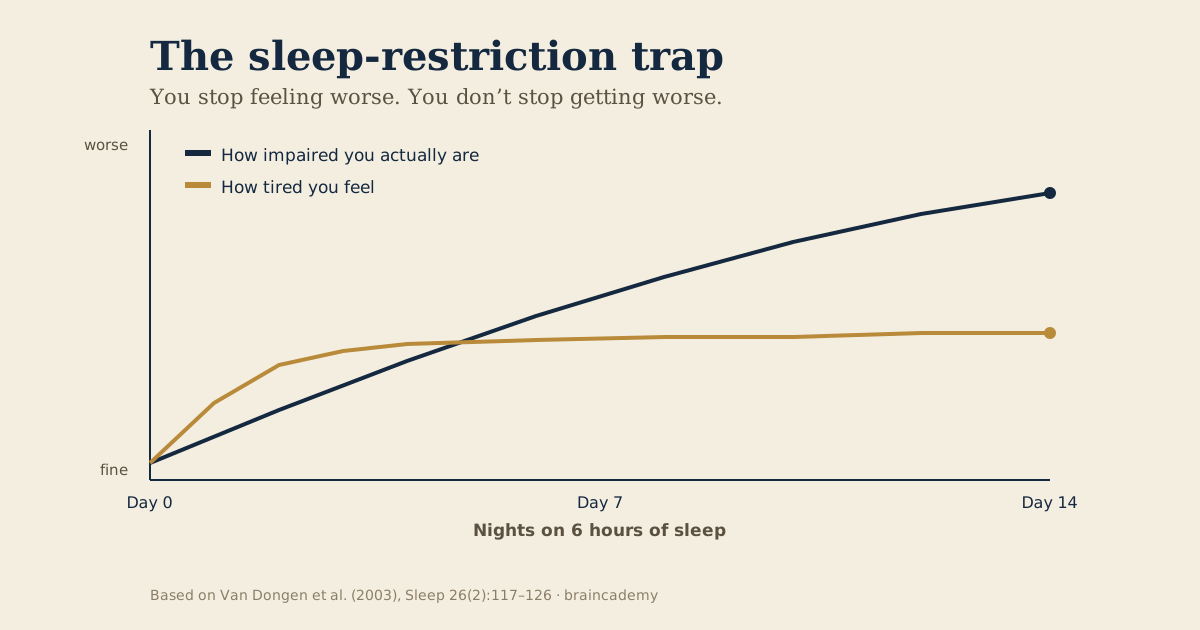
The eight-hour group held steady. The restricted groups did not. Their attention kept sliding, night after night, no floor, no plateau. And here’s the number that stops me every time: after two weeks, people limited to six hours or less were performing as badly as people who’d been kept awake for up to two nights straight.[1] Six hours or less. The amount half the internet calls ‘plenty, if you’re disciplined.’
As the sleep researcher Daniel Erlacher lays it out, the early lab work that once suggested we could happily trim down to five or six hours got fundamentally revised once people looked closer.[2] The trimming has a cost. The cost just shows up somewhere you weren’t looking.
Why you think it’s working
Because here’s the part that reframed the whole thing for me. In that same study, they also asked people how sleepy they felt. And the feeling… leveled off. After the first couple of rough days, the restricted groups stopped reporting that they felt any worse, even as their actual performance kept falling off a cliff.
Read that twice, because it’s the whole thing. Your sense of how tired you are stops tracking how impaired you actually are. You adapt to the feeling. You do not adapt to the deficit. Erlacher describes the same trap from the other direction: cut your habitual sleep and your daytime sleep-pressure climbs (measurably, in the lab) without the person being remotely aware of it.[2]
Figure 1
How tired they felt vs. how they performed
How sleepy they felt
- Rough for the first couple of days
- Then the feeling leveled off
- They stopped reporting feeling worse
How they actually performed
- Attention kept sliding, night after night
- No floor, no plateau
- Six hours or less ended up as bad as up to two nights awake
So when I stood there feeling fine on five hours, feeling like I’d cracked some code? That feeling was real. It just wasn’t information. It was a broken gauge reading empty as full.
And it stacks, quietly. Every short night adds a little to a running tab (a sleep debt), and the tab doesn’t clear itself just because you’ve stopped noticing it. One glorious weekend lie-in patches the sharpest edge, sure, but it doesn’t wipe two weeks of interest. That was the other thing I got wrong: I thought ‘catching up on Saturday’ was a reset button. It’s more like a minimum payment.
But some people really do sleep less, don’t they?
Yes, and this is where the myth borrows its credibility. Sleep need genuinely varies. In one long study, an ordinary group of young adults ranged from five and a half hours a night all the way to ten, with a real slice of them qualifying as natural short sleepers.[2] So the six-hour person you envy might not be lying.
But two catches. First, when researchers tracked the same people over years, they found no stable club of ‘short sleepers’ you can just decide to join. The labels didn’t hold still. Second, the truly rare people who thrive on five or six hours are born that way, carrying uncommon gene variants. They didn’t train into it. There’s no audition.
Figure 2
Tolerating less sleep is not needing less
What you can train
- Ignoring the alarm bell
- Feeling fine on short nights
- Meanwhile, performance keeps falling
What you can't
- Your sleep need: close to fixed
- Natural short sleepers are born with rare gene variants
- Memory, mood and metabolism keep getting billed
The reaction to sleep loss is weirdly personal too: some people crater fast, others are startlingly resilient. But ‘resilient’ here just means their reaction time holds up a little better. Memory, mood, metabolism, immune function: those keep getting billed regardless of how tough you feel.
What to do instead: make the hours you get actually count
So if you can’t safely shrink the number, the only real move is to make each hour you do get pull more weight. Better sleep, not less: more of the night spent in the deep, restorative stuff, less of it half-surfacing.
A few levers that actually move it: get your schedule anchored so you’re sleeping with your body clock instead of against it, drop the room to the temperature that lets you sink, and (the cheapest, most embarrassingly effective one) make the room properly dark.
In a lab study, sleeping with the room light on pushed people toward lighter sleep, with less of the deep kind, the layer that does much of the memory-filing and physical repair.[3] Blackout curtains if you can. A good mask if you can’t.

Disclosure: Amazon affiliate link · I only point at gear I actually sleep with.
The thing nobody tells you
You will never feel your way to the right amount of sleep. That’s the quiet punchline of the whole restriction research. The gauge breaks, and it breaks in the direction that flatters you. The worse off you are, the more ‘adapted’ you feel.
So no, you can’t train your brain to need less sleep. But you can do the honest version: find the number where your performance holds (not your mood, your performance) and then defend it like it matters. Because it’s doing the quiet work of keeping the real you online. Embarrassingly simple. Almost insulting. Same as always.
[1] Van Dongen, H. P. A., Maislin, G., Mullington, J. M. & Dinges, D. F. (2003). “The cumulative cost of additional wakefulness: dose-response effects on neurobehavioral functions and sleep physiology from chronic sleep restriction and total sleep deprivation.” Sleep, 26(2), 117–126.
[2] Erlacher, D. (2019). Sport und Schlaf. Springer.
[3] Mason, I. C. et al. (2022). “Light exposure during sleep impairs cardiometabolic function.” PNAS, 119(12), e2113290119.
You can’t train away your sleep need, so make the night you get do more. The Deep Sleep Guide puts the core levers in one plan (light, rhythm, wind-down, bedroom), plus what to do when you lie awake at night and a printable sleep log. 16 pages, €4,99.
GET THE GUIDE →Tools we rate for this. Some are affiliate links, so we may earn a small commission if you buy through them, at no extra cost to you.
Comments
0 comments