
Why do I lose focus after lunch?
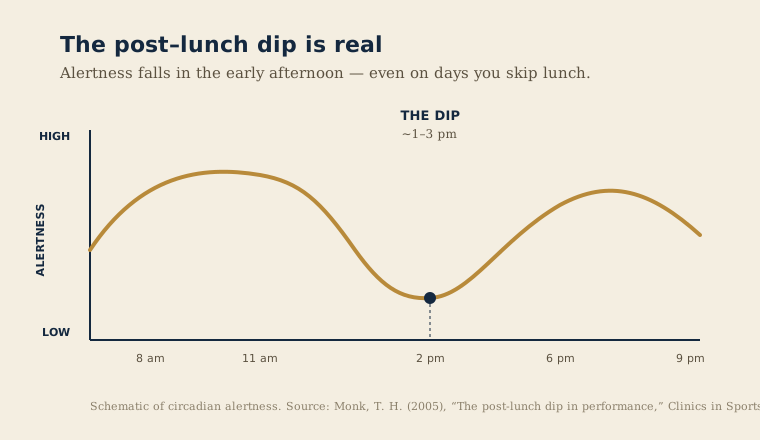
Every day, same thing. Morning me is sharp, gets things done, feels basically unstoppable. Then around 2pm someone unplugs my brain and I’m re-reading the same sentence four times, staring at it like it’s written in a language I used to know.
For years I had one explanation and it was wrong. So let’s just ask it straight: why do I lose focus after lunch? Is it the food, or is something else going on? Turns out it’s mostly not the sandwich. It’s a real, measurable dip that’s partly baked into your biology, and once I understood that, I stopped fighting it in the dumbest possible way.
Why do I lose focus after lunch? The post-lunch dip, explained
There’s a name for it, which was weirdly comforting: the post-lunch dip. And here’s the part that flipped it for me: it happens even when there’s no lunch.
Researchers have shown the early-afternoon slump in alertness and performance shows up even in people who skipped the meal entirely.[1] Which means the sandwich isn’t the villain I’d cast it as. Your internal clock has a genuine trough built into the early afternoon, a natural low point in the same 24-hour rhythm that puts you to sleep at night. The dip is partly just… the schedule your body runs on.
That reframed the whole thing. I’d been treating 2pm-me as a personal failure: lazy, undisciplined, weak. But it’s not a character flaw. It’s a clock.
What’s actually happening in your brain
Attention isn’t a thing you decide to have. It rides on the brain’s underlying arousal, and that arousal has a visible signature. The neurophysiologist Heiko Luhmann describes how sharp, focused attention shows up as fast gamma rhythms in the brain, and how, as relaxation and fatigue set in, those rhythms slow right down.[2]
So the afternoon fog isn’t you being dramatic. Your brain’s arousal genuinely dips. You can’t white-knuckle your way back to sharp focus by frowning harder at the screen. I tried, for years, it doesn’t work.
Three things it’s not
Before the fixes, let me clear out the wrong explanations, because I believed all three and each one sent me the wrong direction.
It’s not blood “rushing to your stomach.” This is the one everyone repeats: that digestion pulls blood away from your brain and that’s why you fog out. It’s a myth. Your brain’s blood supply is fiercely protected; it doesn’t get quietly drained because you ate a wrap. The dip is a timing thing, not a plumbing thing.
It’s not that you’re lazy. I spent an embarrassing amount of energy on this story: that morning-me was the “real” me and afternoon-me was just… slacking. But you can’t be lazy at a fixed hour every single day. That’s not a personality. That’s a rhythm.
And it’s not always “you need more sleep.” Bad sleep deepens the dip, sure, but the dip is still there on your best-rested days. Many well-rested people still get an afternoon trough. So “just sleep more” helps at the edges, but it won’t delete a thing your clock is choosing to do on purpose.
Okay, but the food does matter
Here’s the “or actually…” turn. The clock sets the dip, but what you eat decides how hard it hits.
A big, carb-heavy lunch (the white-bread-and-pasta special) tends to deepen the dip.[1] It lands right on top of the natural afternoon trough, and now two things are dragging you down at once. And meal size seems to matter too: a heavy lunch tends to leave you sleepier than a light one.
So the food isn’t the cause. It’s the amplifier. Which is honestly good news, because the amplifier is the part you can turn down.
Figure 1
The clock sets the dip, lunch turns it up
Your clock: the cause
- A natural early-afternoon trough
- Shows up even when people skip lunch
- Still there on well-rested days
Your lunch: the amplifier
- A big, carb-heavy lunch deepens it
- A heavy lunch leaves you sleepier than a light one
- The part you can turn down
How to actually get through the dip
Once I stopped blaming myself and started working with the clock, a handful of small things did most of the work.
Eat the lighter lunch. Protein and fiber and something green, and go easy on the fast carbs. You want the fuel without the spike-and-crash. Save the big pasta bowl for a night you’re not trying to think afterward.
Walk right after. This one’s almost annoyingly effective. A short walk after eating blunts the blood-sugar spike. I wrote out the mechanism in the after-meal walk that blunts your blood-sugar spike. Ten, twelve minutes. It stacks two wins: flatter glucose, and a hit of movement and light.
Get outside for the light. The same daylight that anchors your morning also props up afternoon alertness. Two minutes on a balcony beats a fourth coffee, and doesn’t cost you tonight’s sleep. Even a grey, overcast sky is many times brighter than your desk lamp. You don’t need sunshine, you just need out. I keep the shortest walk stupidly low-stakes: to the corner and back, no phone.
Time your caffeine for the dip. Not at 8am when you’re already sharp. Save some for the trough, early enough that it doesn’t cost you tonight’s sleep. Some people pair it with L-theanine; here’s what the research says about the L-theanine and caffeine ratio.
Match the work to the energy. Stop scheduling your hardest thinking for 2pm and losing every day. Do the deep-focus block in the morning, when alertness is typically higher; hand the dip the low-stakes stuff: email, admin, the meeting that doesn’t need you at full brightness.
Figure 2
A day built around the dip
- MorningHardest thinking, while alertness is typically higher.
- LunchLighter: protein, fiber, something green.
- Right afterA short walk outside, for movement and daylight.
- The dipCaffeine early enough for tonight's sleep; email, admin, low-stakes work.
One more thing people ask about: the raw materials. B-vitamins and magnesium contribute to normal energy metabolism and nervous-system function. Supplements only help if your diet falls short. There’s no good evidence they soften the dip otherwise.

Disclosure: affiliate link (WeightWorld via AWIN) · I only point at what I actually take.
The thing nobody tells you
The dip is not a bug to be eliminated. It’s a feature of the same clock that lets you sleep at night, and you’re not going to caffeine your way out of a circadian rhythm. Or actually, you can try, and late caffeine costs you sleep that night.
So stop fighting it. Feed it lighter, walk it off, catch some light, spend your caffeine wisely, and hand it the boring work. The point was never to defeat the afternoon. It was to stop scheduling my best thinking for the exact hour my brain clocks out, and to give the low point a little less to drag down.
[1] Monk, T. H. (2005). “The post-lunch dip in performance.” Clinics in Sports Medicine, 24(2), e15–e23.
[2] Luhmann, H. J. (2020). Hirnpotentiale. Springer.
Working with the afternoon dip is one lever. Biohacking Secrets covers ten everyday levers (light, movement, recovery and more) in one 47-page guide.
GET THE GUIDE →Tools we rate for this. Some are affiliate links, so we may earn a small commission if you buy through them, at no extra cost to you.
Comments
0 comments