
When to take supplements for sleep and focus
Most supplement disappointment isn’t a dose problem. It’s a clock problem.
The same compound, same amount, taken four hours apart, can help, do nothing, or actively work against you. Melatonin is the clearest case, and it is the one almost everyone takes at the wrong hour.
Caffeine: it’s later than you think
Caffeine has a half-life of roughly five to six hours in most adults. Drink 200 mg at 4pm and about 100 mg is still circulating at 10pm.
A controlled trial gave people 400 mg at bedtime, three hours before, and six hours before, and measured sleep objectively. All three disrupted sleep, including the six-hour dose, which cost about an hour of sleep. And crucially, participants taking it six hours early did not notice any impairment. [1]
Figure 1
One large dose, three different times
- At bedtimeSleep disrupted.
- Three hours beforeSleep disrupted.
- Six hours beforeStill disrupted: about an hour of sleep lost, unnoticed by the people taking it.
That last detail is the whole problem. The people harmed by the afternoon coffee are exactly the people convinced it doesn’t affect them.
Practical: last caffeine eight hours before bed. For an 11pm bedtime that is 3pm. If that sounds extreme, the six-hour dose still cost an hour of sleep.
Genetics matter here (some people clear caffeine roughly twice as fast as others), but you cannot tell which you are from how alert you feel. Alertness is the compound working, not evidence it has left.
Melatonin: a clock signal, not a sedative
This is the one worth changing today. Melatonin is not a sleeping pill. It is the message your body sends to announce that biological night has started, and its main job is shifting when you get sleepy.
Two consequences:
- Timing beats dose. Taken two to three hours before your target bedtime, it advances your clock. Taken at bedtime, it has only a small sleep-promoting effect. Its real strength is shifting the clock.
- Less is more. Doses around 0.3–0.5 mg approximate what your body actually produces. The 5 and 10 mg tablets on shelves are ten to thirty times physiological, and higher doses are more associated with grogginess than with better sleep.
Where it genuinely earns its place: jet lag and a delayed body clock. Where it mostly disappoints: ordinary can’t-switch-off insomnia, which is usually an arousal problem, not a clock problem.
Safety note: melatonin is sold as a supplement, not regulated like a drug, and labels are often inaccurate: one analysis found products ranging from 83% below to 478% above the stated dose. Low doses (0.5–1 mg) are often enough; the CDC advises against more than 5 mg. Ask a doctor first if you’re pregnant, giving it to a child, or take other medications.
Magnesium: evening, and the form matters
Magnesium is involved in hundreds of processes including the systems that quiet neural activity, and mild insufficiency is common.
Take it in the evening, 60 to 120 minutes before bed. Form matters more than most labels admit: glycinate is generally well tolerated; oxide is cheap, poorly absorbed (around 4%), and mainly known for its laxative effect. If magnesium once “did nothing except send you to the bathroom”, you probably met oxide.
Expect something modest. It is a floor-raiser, not a switch.
L-theanine and caffeine: together, morning
L-theanine is often paired with caffeine to take the edge off its jitter. The evidence on jitter is mixed, but in several trials the pair improved accuracy on attention tasks. Trials have used combinations like 100 mg theanine with 50 mg caffeine, taken together.
Theanine alone in the evening is sometimes recommended for relaxation. It is harmless and mild; I would not expect much.
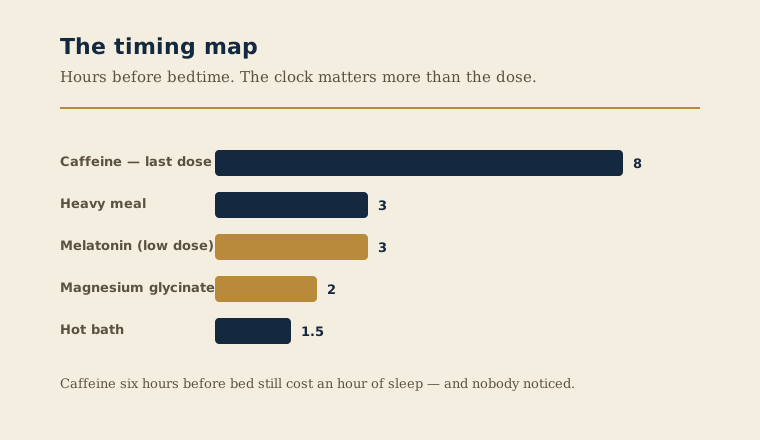
The timing map
- Morning: caffeine (ideally 60–90 minutes after waking, not before), L-theanine alongside it, vitamin D with a meal containing fat.
- Afternoon: caffeine cut-off eight hours before bed. This is the single highest-value item on the list.
- 2–3 hours before bed: melatonin, low dose, only if you are shifting a clock.
- 1–2 hours before bed: magnesium glycinate.
Figure 2
The timing map
- MorningCaffeine, with L-theanine alongside; vitamin D with a meal containing fat.
- AfternoonCaffeine cut-off, the single highest-value item.
- Earlier in the eveningMelatonin, low dose, only if you are shifting a clock.
- Closer to bedMagnesium glycinate.
What no timing can rescue
If your room is warm, your schedule moves by two hours between weekdays and weekends, and you are drinking most evenings, no supplement schedule will fix your sleep. Alcohol in particular cuts REM and fragments the second half of the night.
Supplements are the last few percent. Taken at the right hour they are a real few percent, but they are the last ones, not the first.
The 90-minute rule for your first coffee
Cortisol peaks naturally in the first half hour after waking. Caffeine taken into that peak adds alertness you were already getting for free, and the common experience is a harder crash mid-morning.
Waiting 60–90 minutes lets the natural peak do its work and puts the caffeine where the dip starts. The evidence here is thinner than for the evening cut-off. Treat it as a reasonable habit rather than an established finding. It costs nothing to try for a week.
With food or without
Worth getting right because it changes absorption more than most people expect:
- Fat-soluble vitamins (D, K2, E, A): with a meal containing fat. Taken on an empty stomach, a meaningful share simply does not get absorbed.
- Magnesium: either, but with food if it upsets your stomach.
- Iron: away from coffee, tea and calcium (all three markedly reduce absorption). Vitamin C helps it.
- Melatonin: a large meal delays absorption and therefore the timing you were trying to hit. Take it away from dinner.
Why splitting a dose sometimes matters
For some water-soluble compounds with a short half-life, one large dose produces a spike and then nothing. Two smaller doses hold a steadier level.
Magnesium is different (your body keeps its blood level tightly regulated), so splitting larger magnesium doses mainly reduces stomach upset. Some with dinner, some before bed, usually solves it.
The honest hierarchy
Ranked by how much they change how you actually feel:
- Caffeine timing. Large effect, free, immediate. Nothing else on this list competes.
- Melatonin timing, if you are shifting a clock. Large effect for that specific job, near-zero for anything else.
- Vitamin D, if you are actually deficient, which is worth testing rather than assuming, and common at northern latitudes in winter.
- Magnesium in the evening. Modest, real, cheap.
- Everything else. Mostly marginal, and heavily dependent on whether you were short of it to begin with.
Number one is a scheduling decision, not a purchase. That ordering is not an accident, and it is the part supplement marketing is structurally incapable of telling you.
[1] Drake, C. et al. (2013). “Caffeine effects on sleep taken 0, 3, or 6 hours before going to bed.” Journal of Clinical Sleep Medicine, 9(11), 1195–1200.
Supplement timing is one layer; the everyday basics come first. The Deep Sleep Guide puts the core levers in one plan (light, rhythm, wind-down, bedroom), plus what to do when you lie awake at night and a printable sleep log. 16 pages, €4,99.
GET THE GUIDE →Tools we rate for this. Some are affiliate links, so we may earn a small commission if you buy through them, at no extra cost to you.
Comments
0 comments