
Can you catch up on sleep on the weekend?
Saturday morning used to be the entire point of my week. Five thin nights, then one glorious unset alarm, and I’d surface somewhere around eleven feeling like I’d quietly cheated the system.
Then Sunday evening would arrive and I’d feel… off. Not tired exactly. Fuzzy at the edges, and completely unable to fall asleep at a reasonable hour.
So: can you catch up on sleep on the weekend? Not does it feel good (obviously it feels good). I mean does the payment actually land. Does it clear what the week took out of you.
The answer splits down the middle in a way I found genuinely irritating, honestly. Because half of it is yes.
Can you catch up on sleep on the weekend? The short version
Partly. Some things bounce back fast. Some things don’t bounce back at all.
One long night patches the loudest symptom: the sleepiness. You wake up Saturday and the fog has genuinely lifted, and that lifting is real, not a story you’re telling yourself. What it isn’t is a settlement.
I’ve already gone into why the debt doesn’t quietly evaporate just because you stopped noticing it, so I won’t re-run that here. The question I actually wanted was narrower and much more uncomfortable: when you do pay (two full weekend nights, no alarm), what does the payment buy?
Somebody ran the experiment properly
A team at Colorado did the version you’d want: not a survey, not people guessing at their own bedtimes, but nine days in a lab where the light and the food and the bed times were all controlled.[1]
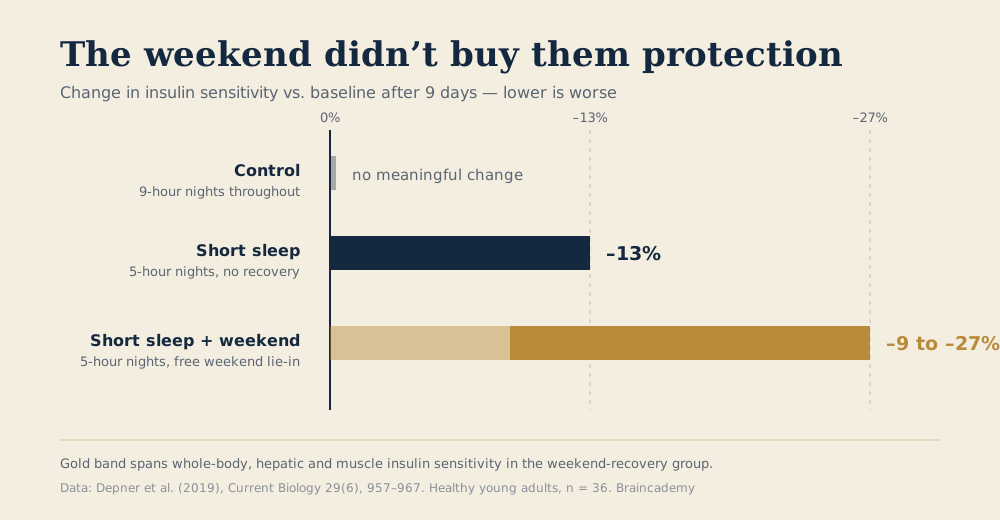
Three groups. One slept nine hours a night the whole time. One was cut to five hours and stayed there. And one, the interesting one, got the pattern most of us actually live: five short nights, then a weekend with no restriction at all, then straight back into short nights.
The weekend group did exactly what you or I would do. Given the chance, they slept longer. Not enormously: about 1.1 hours more than baseline across the whole weekend. Freely, nobody told them to.
And it didn’t save them.
Insulin sensitivity (how well the body handles sugar, which is one of the first things short sleep wrecks) fell about 13% in the group that never got a weekend. In the weekend-recovery group it fell somewhere between 9% and 27%, depending on whether you measured the whole body, the liver, or the muscle.[1]
Read that twice, because I had to. The group that got two full recovery nights was not in better shape than the group that got none.
Figure 1
The weekend didn't protect insulin sensitivity
- ~13%short nights, no weekend recovery
- 9% to 27%short nights with a free weekend in between, depending on what was measured
There was a second thing too, and it’s the one I keep thinking about. After the recovery weekend, when they went back to short nights, their body clock had drifted later, they were eating noticeably more after dinner, and their weight had gone up compared with where they started.[1]
The weekend hadn’t just failed to help. It had left something behind.
Fair caveats, because I don’t want to oversell one study: these were small groups, healthy young adults, nine days. It tells you about the metabolic side of the ledger, not about everything. But it’s the cleanest test of the exact thing we all do, and the result is not the one I wanted.
What the lie-in costs on the other side
Here’s the mechanism, and once you see it you can’t unsee it.
Sleeping till eleven on Saturday and Sunday doesn’t just add hours. It moves your body clock later. Two mornings of no morning light, two late nights: you’ve given yourself a small trip west, every single week.
Then Monday’s alarm drags you back east in one jolt.
So Sunday night insomnia isn’t a mood or a bad attitude about work. It’s a body clock that spent forty-eight hours drifting and is now being asked to sleep two hours before it thinks it’s evening. Which is why the fog on Monday feels so specific: it’s the same fog as a short-haul flight, arriving by duvet.
You pay for the lie-in twice: once in the clock shift, and once on Sunday night when the shift comes due.
The nap repays better than the lie-in
This is the part I wish somebody had told me years earlier.
A nap and a lie-in both add sleep. Only one of them moves your clock.
As the sleep researcher Daniel Erlacher describes it, an afternoon nap is one of the more sensible ways to bring a sleep debt down, and the evidence he points to is unusually concrete. In one study, people whose night had been cut to four hours took a thirty-minute nap, and afterwards their sprint performance over 20 metres improved, their alertness went up, and their sleepiness came down, all measured against the same people on a no-nap day.[2][3]
Thirty minutes. Not a lost morning.
And the reason it works better structurally is almost boringly simple: an early-afternoon nap sits inside your existing day. It doesn’t touch your wake time, so it doesn’t touch your clock. You get the repayment without the drift.
Figure 2
The lie-in vs. the nap
Weekend lie-in
- Adds sleep
- Moves your body clock later
- Sunday night insomnia, Monday fog
Early-afternoon nap
- Adds sleep
- Sits inside your day: wake time stays put
- Twenty to thirty minutes, so tonight's sleep pressure survives
The one rule, and Erlacher is firm on it: don’t nap so long or so late that you bleed off the sleep pressure you need for the night.[2] Twenty to thirty minutes, early afternoon. Past that you’re just borrowing from tonight to pay for last night, which is how the whole mess started.
The trap hiding in “just spend more time in bed”
And then there’s the caution that genuinely changed what I do, which is so counterintuitive I dismissed it the first time.
If you extend your time in bed and can’t actually fill it with sleep, your sleep efficiency drops, and poor sleep efficiency is one of the ways real, persistent sleep problems get manufactured out of nothing.[2] Erlacher’s advice is to pull the extra bed time back rather than lie there hoping.
Which describes my old Saturdays with unpleasant accuracy. Awake at nine. Not getting up until eleven. Two hours of half-dozing that I was mentally filing as “catching up.”
That wasn’t catching up. That was teaching my brain that bed is a place where you lie around awake. Nobody ever repaid a sleep debt by staring at a ceiling.
If you want the extra sleep to be real, the room has to let you take it, which for an afternoon nap in summer is mostly a lighting problem.

Disclosure: Amazon affiliate link · I only point at the category I’d actually buy from.
What I do now instead
The shift was small and weirdly hard: I stopped treating the weekend as the repayment and started treating it as the thing that keeps breaking the repayment.
Wake time stays put. All seven days, within about an hour. Bedtime is the thing that moves. That’s the whole trick, and it’s the opposite of what feels natural.
So when I owe sleep, I pay at the front of the night. Bed at ten on Friday, not up at eleven on Saturday. Same hours, no clock drift, and the difference over a month is not subtle.
Then a nap, early afternoon, dark room, twenty to thirty minutes, when the week has genuinely gone wrong.
And if you’ve already drifted so far that Monday is a wall, that’s a different job, and it’s the one I mapped out in the three-day reset.
Because here’s what the whole thing came down to, in the end. The weekend was never the repayment. It was the interest-only payment I kept mistaking for the balance, and the fix was never going to live on Saturday. It lives on Tuesday.
[1] Depner, C. M., Melanson, E. L., Eckel, R. H. et al. (2019). “Ad libitum weekend recovery sleep fails to prevent metabolic dysregulation during a repeating pattern of insufficient sleep and weekend recovery sleep.” Current Biology, 29(6), 957–967.
[2] Erlacher, D. (2019). Sport und Schlaf. Springer.
[3] Waterhouse, J. et al. (2007). “The role of a short post-lunch nap in improving cognitive, motor, and sprint performance in participants with partial sleep deprivation.” Journal of Sports Sciences, 25(14), 1557–1566.
If the weekend isn’t where you fix this, the weekday is. The Deep Sleep Guide puts the core levers in one plan (light, rhythm, wind-down, bedroom), plus what to do when you lie awake at night and a printable sleep log. 16 pages, €4,99.
GET THE GUIDE →Tools we rate for this. Some are affiliate links, so we may earn a small commission if you buy through them, at no extra cost to you.
Comments
0 comments