
Does taking a break make you more creative?
Here’s the thing I used to do, and it embarrasses me a little. I’d hit a wall on a problem (a paragraph that wouldn’t come, a knot in some logic) and I’d just… stare harder. More coffee. Squint at the screen. As if creativity were a stuck jar I could open by gripping tighter.
It almost never worked. So the honest question: does taking a break make you more creative, or is that just a story we tell ourselves to feel okay about slacking off? Turns out it’s real. But only one specific kind of break does it, and most people take the wrong one.
Does taking a break make you more creative? Here’s what the science says
Yes. The effect is called incubation. You work on a problem, you get stuck, you step away, and the answer arrives later, sideways, in the shower or on a walk. It’s not magic and it’s not laziness. It’s your brain still chewing on the thing while your attention is somewhere else entirely.
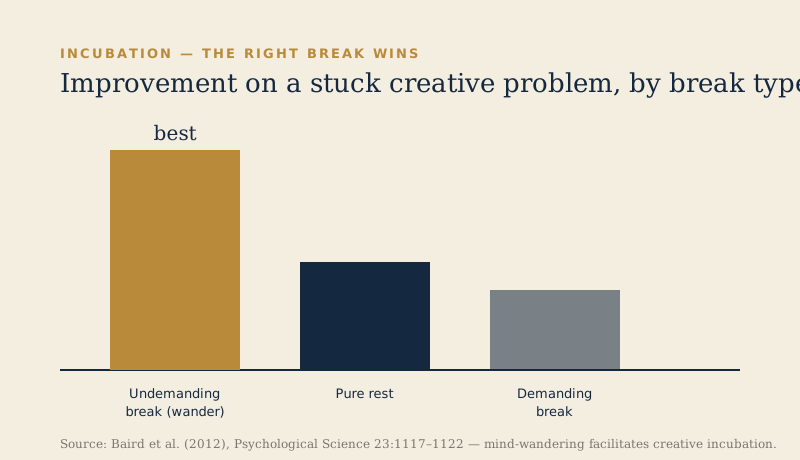
And there’s a beautiful study that pins down which break works. Researchers gave people a hard creative task (coming up with unusual uses for everyday objects), then split them into groups for a break: some did a demanding task, some did an easy, undemanding one, some just rested, some got no break at all. Afterward, everyone went back to the same problems they’d been stuck on. The group that improved most? The ones who’d done the easy, mind-wandering task in between. Not the rest group. Not the busy group. The one where the mind was free to drift.[1]
And here’s the detail that really got me: the improvement only showed up for the problems they’d already been working on. Brand-new problems they hadn’t seen before? No boost. Which tells you something specific about what’s happening: the wandering brain isn’t getting smarter in general. It’s still quietly working on the exact thing you walked away from. That’s incubation, caught on camera.
Figure 1
Which break helped
Improved less
- A demanding task
- Just resting
- No break at all
Improved most
- An easy, undemanding task
- The mind was free to wander
- Only on problems they had already worked on
The shower thing, explained
You already know this feeling even if you’ve never had a word for it. The idea that won’t come at your desk arrives ten minutes into a shower, or halfway through doing the dishes, or (the cliché for a reason) on a walk. J.K. Rowling apparently got the whole shape of Harry Potter on a delayed train, just sitting there with nothing to do.
For the longest time I thought that was just luck. Like the good ideas happened to show up during breaks because breaks are when I’m relaxed. But that’s backwards. The breaks aren’t when ideas happen to arrive. They’re what lets the ideas arrive. The desk, the staring, the gripping-the-jar-tighter thing: that’s actively the wrong posture for the kind of loose, recombining thought creative problems need. Concentration is great for executing. It’s kind of terrible for finding.
Why the boring break beats the relaxing one
This is the part that flipped it for me. The lever isn’t resting. It’s mind-wandering. And those aren’t the same thing, which I’d completely missed.
When you stop concentrating, a whole network of brain regions switches on. The neuroscientist Marcus Raichle named it the Default Mode Network: the circuit that goes quiet whenever you focus hard, and lights up the moment you stop. As the creativity researcher Konrad Lehmann describes it, this is the brain’s real standby state: not idle at all, but quietly recombining loose ideas in the background.[2] That recombining is where the sideways answer comes from.
So a fully relaxing break (or actually, scrolling your phone) doesn’t do it. Your phone captures attention; it switches the wandering network right back off. What you want is something that occupies your hands and almost none of your head. Washing dishes. A walk with no podcast. Folding laundry. The boring stuff. That’s the secret embarrassingly hiding in plain sight.
This reframes “productive break” completely. We’ve been sold the idea that a good break is an enriching one: read an article, listen to a smart podcast, learn something. But for incubation, all of that is just more input fighting for the attention you’re trying to free up. The most productive thing you can do for a stuck problem is something almost aggressively unproductive-looking. Stare out a window. Wander the block. Let the dishes pile into your hands.
The walk really is the standout, though, and not only for the mind-wandering. Light movement on its own nudges creative output up; there’s solid work showing people generate more and better ideas while walking than sitting.[3] So a walk stacks two levers at once: the body’s moving, and the attention’s off the leash. Which is maybe why “go for a walk” is the most repeated, most ignored advice in the whole creativity canon.
The three breaks that don’t work
Worth naming the traps, because I’ve fallen into all of them.
The phone scroll. Feels like a break, isn’t one. Social feeds are engineered to grab exactly the attention you’re trying to release. You come back more scattered, not more open.
The break before you’ve struggled. Bailing at the first hint of friction. There’s nothing to incubate yet. You haven’t loaded the problem deep enough for the background process to have material. That’s just procrastination wearing incubation’s coat.
The break that becomes the day. A short break is incubation; a lost afternoon is avoidance. The window where the loaded problem stays “warm” is real but not infinite. You want to come back while it’s still live.
How to take an incubation break on purpose
You can actually engineer this instead of waiting for the shower to bail you out.
Load the problem first. Incubation only works if you’ve genuinely wrestled with the thing first: the wandering brain needs raw material to recombine. So push until you’re stuck. Not until you’re bored. Until you’re stuck. That’s the signal to step away.
Then pick an undemanding task. A walk is the gold standard: light movement, no screen, eyes on the middle distance. No music, no podcast, nothing that hijacks the attention you’re trying to set free.
And catch the answer when it lands. This is the part everyone botches. The idea arrives mid-walk, you think “obviously I’ll remember that,” and it’s gone by the second corner. The whole point of incubation is wasted if you don’t capture the thing the instant it surfaces.
I gave up trusting my memory for this and just started carrying a tiny notebook. Not an app. Pulling out my phone re-captures my attention and kills the wandering state I just spent twenty minutes building. A pocket notebook and a pen, scribble it, keep walking.
Figure 2
An incubation break on purpose
- Load the problemPush until you're stuck, not just bored.
- Step awaySomething undemanding: a walk, no screen, no podcast.
- Catch the answerWrite it down the moment it surfaces.
- Come back warmReturn while the problem is still live.

Disclosure: Amazon affiliate link · I only point at gear I actually use.
The thing nobody tells you
Breaks aren’t the opposite of focused work. They’re the other half of it. The deep, concentrated push and the wandering break are two halves of one rhythm, and you need both. Skip the focus and the break has nothing to incubate; skip the break and the focus just grinds in place.
So the practical move: pair your hardest thinking with a real break right after. Do one 90-minute focus block, hit the wall, then walk, and for the focus half, some people pair caffeine with L-theanine, though the evidence is mixed. Focus hard, then wander on purpose. That’s the loop.
[1] Baird B., Smallwood J., Mrazek M.D., Kam J.W.Y., Franklin M.S. & Schooler J.W. (2012). “Inspired by Distraction: Mind Wandering Facilitates Creative Incubation.” Psychological Science, 23(10), 1117–1122.
[2] Lehmann, K. (2018). Das schöpferische Gehirn. Springer.
[3] Oppezzo, M. & Schwartz, D. L. (2014). “Give your ideas some legs: the positive effect of walking on creative thinking.” Journal of Experimental Psychology: Learning, Memory, and Cognition, 40(4), 1142–1152.
The incubation break is one lever; your baseline energy is another. Biohacking Secrets covers ten everyday levers (light, movement, recovery and more) in one 47-page guide.
GET THE GUIDE →Tools we rate for this. Some are affiliate links, so we may earn a small commission if you buy through them, at no extra cost to you.
Comments
0 comments