
Does alcohol make you more creative?
I need to confess the setup for this one, because it’s a little embarrassing. I wrote the loosest, most alive first drafts of my life with a glass of wine going. And for years I quietly gave the wine the credit. So the honest question, the one I actually wanted answered: does alcohol make you more creative, or was I just handing the booze a prize for work I’d have done anyway?
Turns out there’s a real answer, and it’s more interesting than either side wants it to be. Not the romantic “genius needs a drink” story. Not the sober-police “it’s all an illusion” story either. Something in between, and weirdly specific.
Does alcohol make you more creative? What the research actually found
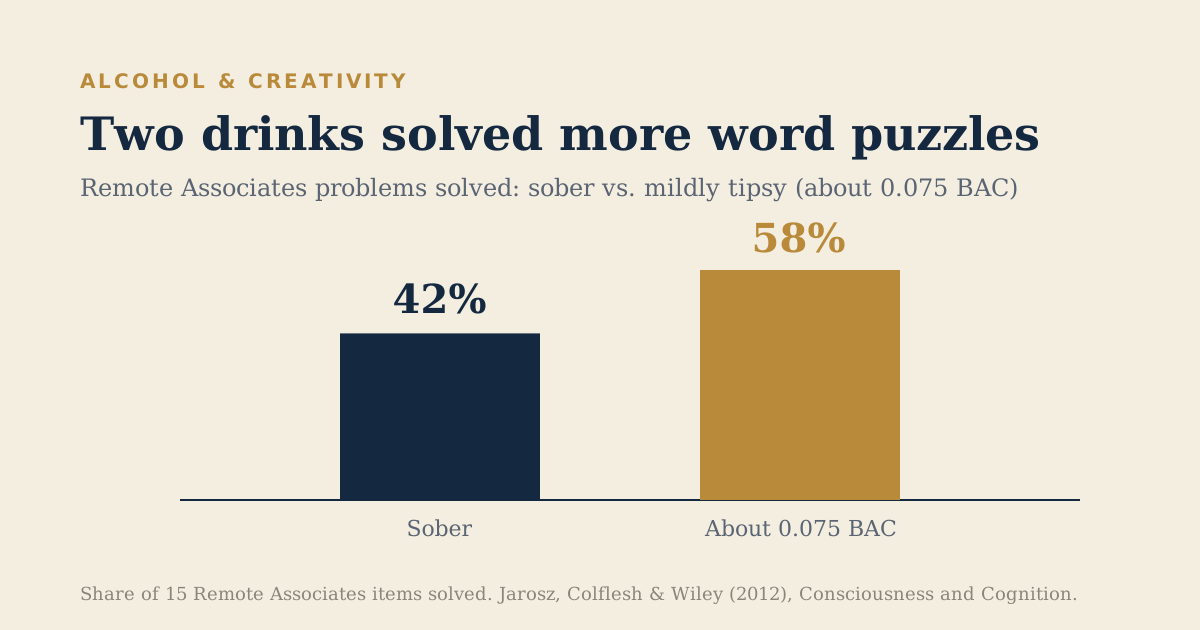
There’s one study everyone ends up pointing at, and for once it earns the attention. Researchers took forty young men, all social drinkers, and split them in two. Half stayed stone sober. Half drank vodka cranberries until they hit about 0.075 blood alcohol: pleasantly buzzed, not drunk, roughly the territory of two drinks.[1]
Then both groups did the Remote Associates Test. You get three words, say peach, arm, tar, and you have to find the single word that links all three. (It’s pit.) It’s a sneaky little test of insight, because the obvious answers are usually wrong, and you have to let your mind drift sideways to land the real one.
The tipsy group won. They solved 58% of the fifteen problems on average, against 42% for the sober group. And they solved them faster, roughly 11.5 seconds a problem versus 15.2. Not just more right answers. Quicker ones, that the drinkers more often described as just arriving rather than being worked out.[1]
Figure 1
Seconds per solved puzzle
So. On that particular kind of problem, the one where you need the sideways leap, yes. A mild buzz helped. Measurably.
Why a little tipsy helps: the bouncer goes off duty
Here’s the part that made it click for me. Alcohol doesn’t add creativity. It subtracts something that was in the way.
The front of your brain, the lateral prefrontal cortex, is your focus and your inner editor. It holds things in working memory, keeps you on task, and quietly says no to the weird association before it ever reaches you. Brilliant for executing. Kind of a buzzkill for finding. As the creativity researcher Konrad Lehmann describes it, a drink loosens exactly that control, so your attention spreads wide and diffuse instead of narrow, and the odd, remote connection finally gets through.[2]
The psychologist William James said it better than I ever could, a century before anyone had a brain scanner. Lehmann quotes him: sobriety diminishes, discriminates and says no; drunkenness expands, unites and says yes. It is, James wrote, the great exciter of the yes in us.[2]
That’s the whole mechanism, honestly. The drink doesn’t make you smarter. It makes you less able to shut your own strange ideas down before you’ve even heard them out.
The catch nobody drinking for inspiration wants to hear
Okay. Here’s where I have to be the friend who ruins it.
That same loosening that helps the sideways leap is the exact thing that wrecks everything after the leap. The buzz that cracked the puzzle is the buzz that then can’t hold the idea still, order it, judge it, and build it into something. Alcohol tanks working memory and concentration. Finding is one job. Making is the other, and alcohol is genuinely bad at the second one.
Figure 2
Finding an idea vs. making something of it
Finding: a mild buzz can help
- The sideways leap on an insight puzzle
- Wide, diffuse attention
- Odd, remote connections get through
Making: alcohol gets in the way
- Holding the idea still
- Ordering and judging it
- Working memory and concentration drop
Which lines up almost too neatly with how real writers actually worked. The list of famous drinkers is long and glamorous, Hemingway and Dylan Thomas and the rest of them. But dig in and most of them did the drinking around the work, not during it. As Lehmann points out, the careful studies of artists and alcohol keep landing on the same unglamorous conclusion: for most of them drink hampered the output more than it helped, and the ones who lasted guarded their working hours and stayed sober at the desk.[2]
And the dose is everything. The study that showed the benefit used one mild buzz, around 0.07. Push past that and you’re not loosening the editor anymore, you’re unplugging the whole machine. There’s no version of this where more is better. The curve turns on you fast.
Two more honest caveats, because I promised honest. The study was small, and all young men. And it measured one narrow flavour of insight puzzle, not “creativity” in the big messy sense of writing a novel or designing a thing. So read it as a real finding, but a narrow one, not a licence.
How to actually use this (without wrecking anything)
If you want the effect without paying the tax, you can mostly get the loosening from things that don’t cost you tomorrow.
A walk does it. So does the shower, the drive, the drift right before sleep. That broad, unfocused, slightly off-duty attention is the actual lever, and a drink is only one clumsy way to reach it. If you want the proper version of this, it’s the same mechanism I wrote about in why a break makes you more creative: step away, let the mind go wide, catch what surfaces.
If you do use a glass of wine as a loosener now and then, two rules keep it honest. Use it for finding, the loose first-draft, throw-everything-at-the-wall phase, never for the editing or the deciding. And keep it to the one-drink buzz, not the second and third, where the gains have already curdled into fog.
And whatever you do, don’t make it a nightly thing, because the bill comes due in your sleep. A nightcap shreds the back half of your night, which is its own long story over in what alcohol does to your sleep. Trading tomorrow’s clarity for tonight’s loose idea is a bad deal on repeat.
The one thing that genuinely matters, buzz or not, is catching the idea the second it shows up. A loosened mind is generous and completely unreliable. The connection that felt like a small miracle at 10pm is gone by morning if you didn’t write it down.

Disclosure: Amazon affiliate link · I only point at gear I actually use.
The thing nobody tells you
The wine was never the talent. That’s the part I had to sit with. It just turned down the part of me that was standing in my own way.
Which means the drink was never really the point. The diffuse, say-yes, un-edited state was the point, and that state is available sober, cheaper, and without the headache. The glass of wine is just the lazy door into a room you can also walk into on a walk.
So: does a drink sometimes spark the sideways idea? Honestly, yes, a little, once, lightly. Is it the thing making you creative? No. You were. The drink just got out of the way, and there are kinder ways to ask it to do that.
[1] Jarosz, A. F., Colflesh, G. J. H. & Wiley, J. (2012). “Uncorking the muse: Alcohol intoxication facilitates creative problem solving.” Consciousness and Cognition, 21(1), 487–493.
[2] Lehmann, K. (2018). Das schöpferische Gehirn. Springer.
A loose mind is one lever for ideas; your baseline energy and focus are another. Biohacking Secrets covers ten everyday levers (light, movement, recovery and more) in one 47-page guide.
GET THE GUIDE →Tools we rate for this. Some are affiliate links, so we may earn a small commission if you buy through them, at no extra cost to you.
Comments
0 comments