
How to get into a flow state faster
For years I treated flow like weather. Something that happened to me on a good day: the work just clicked, an hour vanished, I looked up and it was dark. And on the bad days I’d sit at the same desk, same task, and… nothing. Just friction and tab-switching.
So the question I actually wanted answered was: how to get into a flow state faster, on purpose, on a Tuesday, not by accident. And the annoying, freeing thing I found is that flow isn’t a mood you wait for. It’s a set of conditions. Set them, and the state comes. Miss one, and it doesn’t, no matter how much you want it.
How to get into a flow state faster: match the challenge to your skill
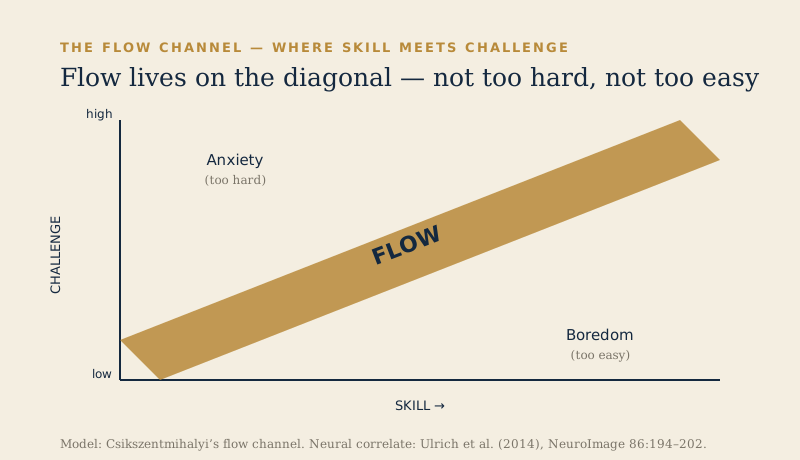
This is the whole game, honestly, and almost everyone gets it wrong. Flow lives on a razor edge between two failure states. Too hard, and you tip into anxiety: the task overwhelms you, your brain floods with “what if I can’t” and the state never arrives. Too easy, and you slide into boredom: your attention wanders off looking for something more interesting. Flow is the narrow channel between those two, where the task stretches you to almost exactly the edge of what you can do.
There’s a lovely little study that proved this with, of all things, Tetris. Researchers dialed the falling-block speed up and down: too slow and players got bored, too fast and they got stressed, but at the speed where they were just barely keeping up, something shifted, and afterward those players estimated the time they’d spent as a quarter shorter than it really was. That time-melting is one of flow’s clearest fingerprints. As the neuroscientist Konrad Lehmann lays it out, the trigger wasn’t the game itself. It was the fit between the demand and the player’s skill.[2]
Which means the fastest way in isn’t hyping yourself up. It’s calibrating the task. If you keep bouncing off something, it’s probably too big. Shrink it until the next move is obvious but not trivial. If you’re bored, the opposite: add a constraint, a timer, a harder target, until it bites again.
Figure 1
Where flow lives
Off the channel
- Too easy: attention wanders off into boredom
- Too hard: the task overwhelms you into anxiety
- Fuzzy goal: part of you keeps monitoring
In the channel
- The task stretches you to the edge of your skill
- One clear goal with instant feedback
- The self-conscious inner voice goes quiet
Give the task a clear goal and instant feedback
The other two ingredients are quieter but they matter just as much. Flow needs a clear goal: not “work on the report” but “draft the opening section.” And it needs immediate feedback, some way to see, moment to moment, whether you’re getting it right. The Tetris player sees the row clear. The writer feels the sentence land. The vaguer your task, the longer flow takes to switch on, because your brain can’t tell if it’s winning.
This is why “be more productive” never produces flow and “fill this one page” often does. A fuzzy goal keeps a part of your mind up in the control tower, monitoring, second-guessing. A sharp goal lets that part go quiet.
And that quieting is not just a metaphor. When researchers put people into flow with mental-arithmetic tasks tuned to each person’s exact skill level and scanned their brains, the flow state showed less activity in the medial prefrontal cortex, a region tied to self-referential thought, the running inner commentary about how you’re doing.[1] That’s the neural version of the thing every artist describes: in flow, the self-conscious voice goes silent. You stop watching yourself work and just… work.
Why interruptions cost so much more than the interruption
Here’s the part that changed how I actually structure my day. Flow is fragile on the way in. Getting there takes time: you have to load the whole problem into your head, feel out the edges, let the self-monitoring drop. And a single interruption doesn’t just cost the two minutes of the interruption. It knocks you clean out of the channel and you have to climb back up the ramp from scratch.
So the maths of a “quick question” is brutal. The question took thirty seconds. Getting back into deep focus afterwards can take many minutes, far longer than the interruption itself. Which is why the single highest-leverage move for getting into flow faster isn’t a technique at all. It’s removing the things that will yank you out before you start. Phone in another room. Notifications off. A door, if you have one. One clean, uninterrupted runway.
The interruption that’s hardest to close is sound: a conversation nearby, a notification chirp, the general open-plan hum. When I genuinely need to drop in fast and I can’t control the room, the cheapest fix that works is just sealing it off.
Disclosure: Amazon affiliate link · I only point at gear I actually use.
The warm-up ritual that gets you there quicker
One more thing, and it’s the one I underestimated longest. Flow rewards a ramp. You almost never drop straight into the channel cold. You enter through an easy on-ramp task that’s clearly within your skill, and let the momentum carry you up into the harder middle. Musicians know this; it’s why they run scales before the real piece. The scales aren’t the work. They’re the door.
So my actual sequence, when I want in fast: same desk, same time, a two-minute throwaway task I know I can do (tidy the notes, re-read yesterday’s last paragraph), then straight into the one sharp goal, room sealed, phone gone. It’s almost boringly mechanical. But that’s the point. The ritual does the work so I don’t have to feel inspired first.
Figure 2
The on-ramp into flow
- Same desk, same timeA fixed place and hour.
- Easy on-rampA short throwaway task you know you can do.
- One sharp goalStraight into the hard part with a clear target.
- Room sealedPhone gone, notifications off.
Because that was the real reframe for me. I’d been waiting to feel like it, waiting for flow to arrive so I could start. Backwards. You build the conditions first, and the feeling shows up second. Every time.
The short version
Get into flow faster by stacking the four conditions on purpose: pick a task at the edge of your skill (not over, not under), give it one clear goal with visible feedback, seal off interruptions before you begin, and warm up with an easy on-ramp instead of waiting to feel ready. It pairs naturally with the rest of the focus system: a proper 90-minute focus block gives flow room to actually build, and when you hit a wall, the right kind of break resets you for the next run.
[1] Ulrich M., Keller J., Hoenig K., Waller C. & Grön G. (2014). “Neural correlates of experimentally induced flow experiences.” NeuroImage, 86, 194–202.
[2] Lehmann, K. (2018). Das schöpferische Gehirn. Springer.
Flow is easier to reach when the basics are in place. Biohacking Secrets covers ten everyday levers (light, movement, recovery and more) in one 47-page guide.
GET THE GUIDE →Tools we rate for this. Some are affiliate links, so we may earn a small commission if you buy through them, at no extra cost to you.
Comments
0 comments