
Does background noise help concentration?
For years I treated silence as the only serious way to work. Library-quiet, door shut, phone in another room: that was the setup, and anything less felt like cheating. Then I spent a whole week trying to write in a dead-quiet flat and got almost nothing done, and started to wonder if I’d had it backwards the entire time.
So let me just ask it straight: does background noise help concentration, or does it wreck it? And the honest answer (the one that took me embarrassingly long to land on) is that it depends entirely on the kind of noise, and the kind of work. Which sounds like a cop-out. It isn’t. It’s the whole key.
Does background noise help concentration? The short version
Total silence is not automatically the winner. A little ambient sound can genuinely help, but there’s a ceiling, and past it noise turns on you fast.
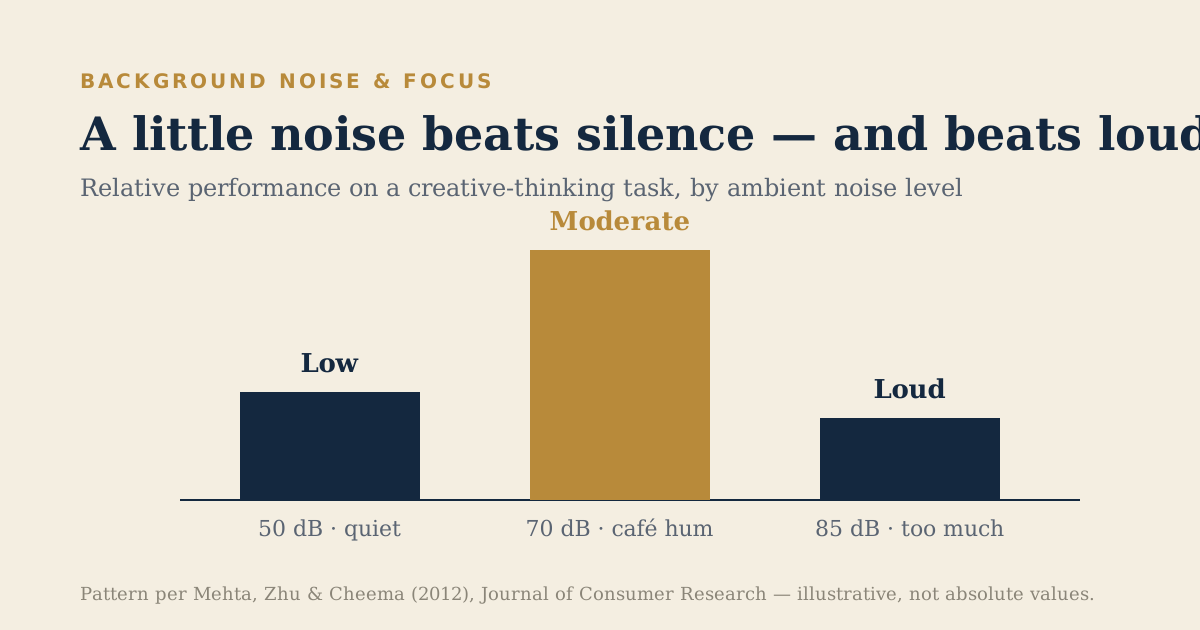
The cleanest evidence comes from a set of experiments by Ravi Mehta and colleagues. They had people work at three noise levels: quiet (around 50 decibels), moderate (around 70, roughly a busy café), and loud (around 85). On creative-thinking tasks, the moderate level beat both the quiet room and the loud one.[1] Not a straight line where more quiet is always better. An upside-down U: a sweet spot in the middle.
Figure 1
Three noise levels, one sweet spot
That was the finding that flipped it for me. My dead-silent week wasn’t discipline. It was me sitting below the sweet spot, understimulated, re-reading the same paragraph.
Why a little noise can actually help
The idea researchers reach for is a mild kind of distraction. A completely silent room lets you clamp down too hard: you over-focus, you get rigid, you keep grinding the same narrow groove. A bit of ambient hum nudges you just off that groove, loosens the grip, and for loose, associative, idea-generating work that’s exactly what you want.
But push it louder and the same distraction stops being a nudge and becomes a load. Now you’re spending real effort just holding your place against the noise, and there’s nothing left for the actual work. Same mechanism, opposite result, which is why it’s a sweet spot and not a slope.
Why the wrong noise destroys focus
Here’s the piece almost nobody separates out, and it’s the one that matters most: not all noise is equal. Decibels aren’t the only thing that decides whether a sound helps or hurts. Meaning is.
Attention is, at its core, a filter. The neurophysiologist Heiko Luhmann describes how the brain is constantly filtering sensory signals. It has to, because the resources for processing information are limited, so only what you actually attend to reliably makes it through.[2] A steady, meaningless sound (rain, a fan, the flat roar of a café) is easy to filter. It fades into the background and stops costing you anything.
Speech does not fade. Words, a conversation two desks over, a podcast, song lyrics: your language system grabs at them whether you want it to or not. You can’t not process meaning; it’s involuntary. That’s why the anonymous hum of a coffee shop is fine but one loud phone call in an open office is ruinous. It’s not that the call is louder. It’s that it’s legible, and your brain keeps trying to read it.
Figure 2
Easy to filter vs. impossible to ignore
Steady, meaningless sound
- Rain, a fan, the flat roar of a café
- Fades into the background
- Stops costing you attention
Speech and lyrics
- A conversation two desks over, a podcast, song lyrics
- Your language system grabs it, involuntarily
- Worst for writing, coding and reading
Or actually, that reframed a decade of complaints for me. I’d always said I “couldn’t work with noise.” Wrong. I couldn’t work with speech. Very different problem, with a very different fix.
So what actually works
Once you split noise into “steady and meaningless” versus “human and legible,” the whole thing gets simple.
Reach for steady, wordless sound. Brown noise, rain, a fan, instrumental music, the generic café roar. It sits you near that middle sweet spot without giving your language system anything to chew on.
Kill the lyrics for hard verbal work. Writing, coding, reading (anything that is language) competes directly with sung words for the same machinery. Instrumental only, or steadier still, pure noise. Save the lyric-heavy playlist for the dishes.
Match the sound to the task. For loose, creative, brainstorm-y work, a little café hum genuinely helps. For a tight deep-focus block on demanding verbal work, lean quieter, or toward pure steady sound, and ideally do that block in the morning window when your attention is already sharpest.
Control the environment instead of enduring it. This is the real lever. The problem with an office or a train isn’t volume. It’s unpredictability, the sudden legible sound you can’t choose. The move is to take that choice back: block the human stuff, and pipe in the steady sound you picked.

Disclosure: Amazon affiliate link · I only recommend gear I actually use.
The thing nobody tells you
It was never silence versus noise. That’s the wrong axis, and I spent years losing on it. The real axis is controllable versus uncontrollable: steady sound you chose versus legible sound that chose you.
The café works because you opted into its hum. The open office fails because your neighbor’s call opts in for you. So stop treating silence as the only virtuous setup, and stop white-knuckling through noise you hate. Pick a steady sound, match it to the task, block the words, and give your attention a room it isn’t fighting.
[1] Mehta, R., Zhu, R. & Cheema, A. (2012). “Is Noise Always Bad? Exploring the Effects of Ambient Noise on Creative Cognition.” Journal of Consumer Research, 39(4), 784–799.
[2] Luhmann, H. J. (2020). Hirnpotentiale. Springer.
Your sound environment is one lever. Biohacking Secrets covers ten everyday levers (light, movement, recovery and more) in one 47-page guide.
GET THE GUIDE →Tools we rate for this. Some are affiliate links, so we may earn a small commission if you buy through them, at no extra cost to you.
Comments
0 comments