
How many hours of deep work are actually possible in a day?
For about two years I blocked eight-hour stretches in my calendar and called them focus days. They were not focus days. They were two hours of genuine concentration wrapped in six hours of email, rearranging, and the particular kind of busywork that feels productive because it is exhausting.
The honest number is smaller than almost anyone admits, and knowing it changes how you plan a week.
What the ceiling actually is
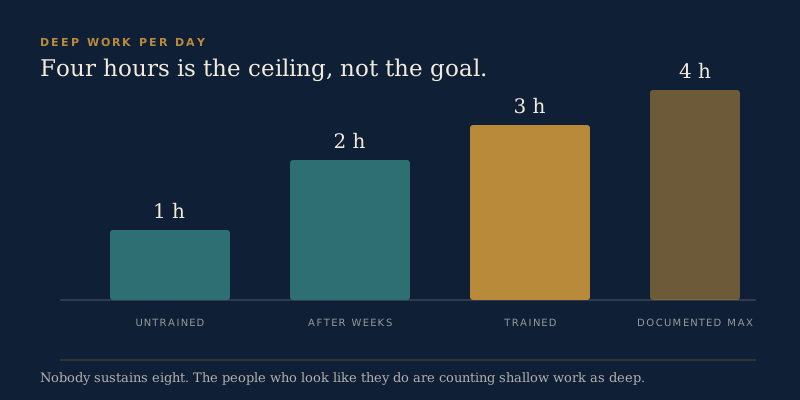
Research on elite performers puts the limit of truly deliberate practice at about four hours a day, and it appears as a ceiling, not an average. [1] Most of us are not elite performers, so expect your own number to sit at or below that. It varies by person, which is why it is worth measuring (more below).
Nobody sustains eight. The people who look like they do are counting shallow work as deep: answering messages, attending meetings, reading things they will not use. That work has to happen, but it does not draw from the same reservoir.
Figure 1
The eight-hour focus day vs. the real ceiling
An eight-hour focus day
- Two hours of genuine concentration
- Six hours of email, rearranging and busywork
- Shallow work counted as deep
The real ceiling
- About four hours a day, even for elite performers
- Most of us at or below that
- One protected block at your best hour
Why the number is so low
Deep work is tiring, and why the limit exists is still debated. Either way, what feels like willpower failure after ninety minutes is a common limit, not a character flaw.
It is also why some people find longer blocks suit them better than 25-minute Pomodoros: fewer restarts, more time actually inside the work.
The mistake that costs the most
Spending the good hours on the wrong work. Most people have a window (often mid-morning) where concentration is cheapest, and they fill it with email because email is easy to start. The demanding work then lands in the afternoon, when the post-lunch dip makes it harder.
Protecting one window is worth more than adding three.
How to find your own ceiling
For one week, note when you start a genuinely demanding task and when the quality drops (not when you stop, but when you notice yourself rereading the same paragraph). Most people find the same time of day and the same duration appearing again and again. That is your number.
Then plan against it honestly: one protected block at your best hour, everything else scheduled around it rather than the other way round.
Figure 2
Find your own ceiling
- Log a weekNote when each demanding task starts.
- Mark the dropNote when quality slips, like rereading the same paragraph.
- Spot the patternThe same time of day and duration keep appearing.
- Protect itOne block at your best hour; plan the rest around it.
The one-sentence version
You do not have eight hours of deep work in you, and neither does anyone else. You have a few at most (around four seems to be the ceiling even for elite performers), and the whole game is spending them on the right thing.
[1] Ericsson, K. A., Krampe, R. T. & Tesch-Römer, C. (1993). “The role of deliberate practice in the acquisition of expert performance.” Psychological Review, 100(3), 363–406.
Protecting your few real deep-work hours is one piece; the energy you bring to them is another. Biohacking Secrets covers ten everyday levers (light, movement, recovery and more) in one 47-page guide.
GET THE GUIDE →Tools we rate for this. Some are affiliate links, so we may earn a small commission if you buy through them, at no extra cost to you.
Comments
0 comments