
Vagus nerve exercises: do they actually work?
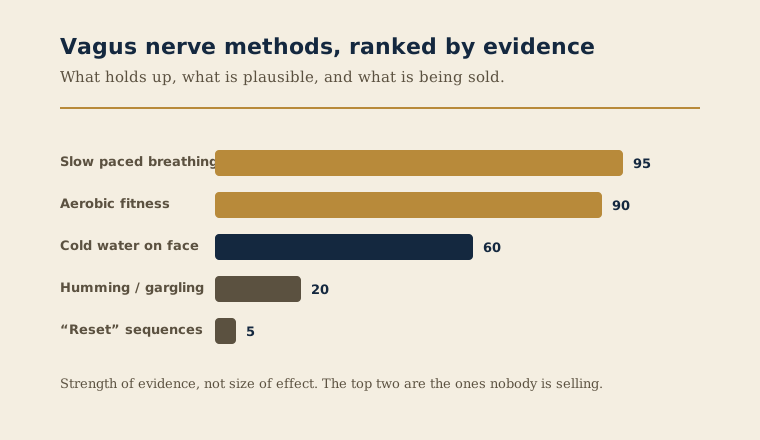
The vagus nerve has become the thing everything gets blamed on. Bad sleep, bloating, anxiety, burnout: somewhere there is a video telling you to hum at it.
Some of this is real physiology. Some of it is a real nerve doing real work being sold as a magic switch. It took me a while to separate the two, so here is the separation.
What the nerve actually is
The vagus is the main line of the parasympathetic system, the “rest and digest” side. It runs from the brainstem down to the heart, lungs and gut, and about 80% of its fibres carry information upward, from the body to the brain.
That last detail is the interesting one. It means the traffic is mostly your organs reporting their state to your brain, not your brain issuing orders. Your sense of being calm is downstream of what your body is telling you.
Which is why body-first methods work at all, and also why the claims get out of hand. You cannot “reset” a nerve. You can change what it reports.
What has real evidence
1. Slow paced breathing: strongest
Around six breaths a minute, most people hit what’s called resonance: heart rate, breathing and blood pressure fall into step and the swing in heart rate gets much larger. Larger swing means more vagal activity. This is the best-documented method there is, and it’s the mechanism behind HRV biofeedback. [1]
Practically: inhale four seconds, exhale six. Ten minutes. Nothing else required.
2. Cold on the face: moderate
Cold water on the forehead and around the eyes triggers the diving reflex: heart rate drops within seconds. It’s a genuine reflex, not a wellness claim. Splashing your face with cold water works; so does a cold cloth held over the eyes for thirty seconds.
Note what this is good for: it is fast and short-lived. A circuit breaker, not a treatment.
3. Humming, gargling, singing: weak
The reasoning is that the vagus supplies muscles in the throat, so using them stimulates it. That anatomy is correct. Whether it produces a measurable, lasting change in vagal tone is not established: the studies are small and the effect sizes wobble.
It is pleasant and harmless. I would not build anything on it.
What doesn’t hold up
“Vagus nerve reset” sequences. Usually a set of eye movements or neck stretches promising to fix chronic conditions in minutes. No, and the promise itself is the tell.
Ear clips and cheap stimulators. Transcutaneous vagus nerve stimulation is a real research area with real devices. What’s sold online for €40 is mostly not that.
“Low vagal tone” as a diagnosis. Vagal tone varies enormously between healthy people, and mostly with age and fitness. A number from a wearable is not a condition.
The thing that changes it most, and nobody sells it
Aerobic fitness. It raises resting vagal activity more reliably than any breathing protocol, and the effect is durable rather than lasting fifteen minutes.
Nobody makes a video about it because “go for regular runs for three months” is not a hack. It just happens to be the answer.
So what do you actually do
- Daily: ten minutes of six-breaths-a-minute. Free, evidenced, boring.
- In a spike: cold water on the face. Thirty seconds.
- Over months: aerobic training. This is the one that moves the baseline.
- Skip: resets, ear clips, and any sentence containing the word “unlock”.
Figure 1
Worth doing vs. skip
Worth doing
- Slow breathing, around six breaths a minute: strongest evidence
- Cold water on the face: a fast, short-lived reflex
- Aerobic training: moves the baseline over months
Skip, or don't build on it
- Humming, gargling, singing: small studies, wobbly effects
- Reset sequences promising quick fixes
- Cheap ear clips sold online
- A wearable number read as a diagnosis
The nerve is real. The switch is not. What you have is a set of small levers on how your body reports its own state. Used daily, that turns out to be enough.
Why the marketing is so aggressive
Two things make the vagus nerve unusually easy to sell. It touches nearly every organ, so almost any symptom can be attributed to it. And it is genuinely modifiable, so the underlying claim is not a lie, just enormously inflated.
That combination is ideal for content: a real mechanism, a wide symptom list, and no easy way for the reader to check. Watch for the tell: whenever a single intervention is claimed to fix digestion, anxiety, sleep and inflammation at once, the mechanism has stopped doing work and started doing marketing.
The measurement problem
“Vagal tone” is usually measured through heart rate variability, and HRV is a rough proxy at best. It moves with age, fitness, posture, breathing rate, hydration, time of day and the previous night’s alcohol.
Which means: do a breathing exercise while sitting still, and your HRV rises, because you are sitting still and breathing slowly. That is not evidence the exercise changed your nervous system. It is evidence you were measuring during the exercise.
If you want to know whether something moved your baseline, compare morning readings taken in the same position on the same device across weeks. Single measurements around an intervention tell you almost nothing.
What six breaths a minute actually feels like
Slower than people expect. Ten seconds per full cycle is a long time, and the first few minutes feel like not quite enough air. That sensation is normal and passes. It comes from the change in rhythm, not from any actual shortage.
Practically: four seconds in through the nose, six out through the nose or mouth. Don’t force the bottom of the exhale. If ten seconds feels too long, start at three-and-five and lengthen over a week.
Figure 2
One slow breath, about ten seconds
- InFour seconds, through the nose.
- OutSix seconds, nose or mouth. Don't force the end.
- RepeatAround six breaths a minute.
- Build upTen minutes is the usual dose in the research; shorter is better than none.
Ten minutes is the usual dose in the research. Five is better than none, and consistency beats duration.
The gut question
The vagus does carry signals between gut and brain, and this is a serious area of research. It does not follow that humming improves digestion.
What is reasonably established: eating in a settled state rather than a rushed one changes gut motility, and stress affects digestion through several routes including the vagus. What is not established: that any specific exercise reliably fixes gut symptoms. If you have persistent digestive problems, that is a doctor question, not a breathing-technique question.
[1] Lehrer, P. M. & Gevirtz, R. (2014). “Heart rate variability biofeedback: how and why does it work?” Frontiers in Psychology, 5, 756.
Slow breathing is one lever for recovery. The Deep Sleep Guide puts the core levers in one plan (light, rhythm, wind-down, bedroom), plus what to do when you lie awake at night and a printable sleep log. 16 pages, €4,99.
GET THE GUIDE →Tools we rate for this. Some are affiliate links, so we may earn a small commission if you buy through them, at no extra cost to you.
Comments
0 comments