
How to calm your nervous system fast
I used to think calming down was a matter of deciding to. Sit still, breathe, be reasonable about it. It never once worked while my heart was going.
What changed things was finding out the order is backwards. You don’t calm your mind and let the body follow. The body has a lever, the lever is the exhale, and the mind comes along afterwards whether it likes it or not.
Why the exhale is the lever
Your heart rate isn’t steady. It speeds up slightly when you breathe in and slows down when you breathe out, every single breath, all day. That’s the vagus nerve doing its job: it releases the brake on the inhale, and reapplies it on the exhale.
Which gives you something unusually direct. Make the out-breath longer than the in-breath and you are holding that brake down for longer. Not metaphorically. It is a mechanical relationship, and it works whether or not you believe in it.
This is why “just breathe” advice so often fails, by the way. Told to breathe deeply, most people take big dramatic inhales, which is the half that speeds the heart up.
The five-minute method that beat meditation
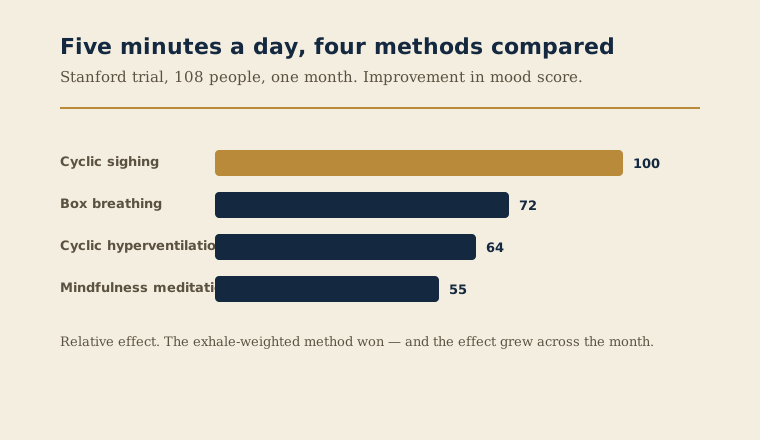
In 2023 a Stanford group ran the comparison properly. 108 people, four groups, five minutes a day for a month: cyclic sighing, box breathing, cyclic hyperventilation, or mindfulness meditation. [1]
Cyclic sighing came out on top. It was the only method that clearly beat meditation: a bigger improvement in mood, a bigger drop in breathing rate, and the effect built over the month rather than fading.
The method itself is almost annoyingly simple:
- Inhale through the nose until your lungs feel comfortably full.
- Second short inhale on top of it: a sniff, to pop open the air sacs that collapsed.
- Long, slow, unforced exhale through the mouth. Let it run out.
- Repeat for five minutes.
Figure 1
Cyclic sighing, one round
- InhaleThrough the nose until your lungs feel comfortably full.
- Top it upA second short inhale on top: a sniff.
- Long exhaleSlow and unforced, through the mouth. Let it run out.
- RepeatKeep going for five minutes.
That double inhale is the part people skip and it is the part that matters. It’s the shape of a natural sigh, the thing your body already does a few times an hour without asking you.
What “fast” honestly means
Many people feel calmer after just a few sighs, and that is genuinely useful in a lift before a meeting. The study itself tested five minutes a day, though. And this is not a treatment for panic disorder.
But the mood effect in the study came from daily practice, not from one rescue attempt. So there are two different tools here wearing the same name:
- The rescue: three sighs, right now, when your chest is tight.
- The baseline shift: five minutes a day, and after a couple of weeks the floor you return to is lower.
Only the second one changes what your ordinary Tuesday feels like.
Figure 2
The rescue vs. the baseline shift
The rescue
- Three sighs, right now
- When your chest is tight
- Many people feel calmer within a few sighs
The baseline shift
- Five minutes a day
- In the trial, mood improved across the month
- The floor you return to gets lower
Two things that make it stop working
Forcing the exhale. Squeezing the last of the air out is effort, and effort is arousal. It should feel like letting go of a held object, not like blowing up a balloon.
Doing it only when you’re already flooded. If the first time you try this is mid-panic, it will feel like it isn’t working, because you have no reference point for what it does. Learn it calm. Use it hot.
Where this fits
A calm nervous system is not a mood. It’s a state you can enter on purpose, and the entry point is unglamorous: one long exhale after a double inhale, repeated.
It also stacks with everything else that lowers baseline arousal: a cool room, light in the morning, caffeine that stops early enough. None of those are dramatic either. Together they decide how reactive you are before anything has even happened.
Why the mind-first approach keeps failing
The standard advice is to notice the thought, question it, replace it. That works, hours later, in a journal. It does not work at minute one, and the reason is structural.
Under real arousal, the parts of the brain that do careful reasoning are the parts operating worst. Asking them to talk you down is asking the flooded department to fix the flood. Meanwhile the breath is controlled by a system that keeps working regardless, and it has a direct line to heart rate.
So you are not choosing between body and mind. You are choosing the door that is still open.
What about box breathing?
Four in, four hold, four out, four hold: the method the military made famous. It was in the Stanford comparison too. Cyclic sighing was the only method that clearly beat meditation; box breathing trended the same way, but not significantly.
One plausible reason is the ratio. Box breathing has equal inhale and exhale; cyclic sighing is heavily exhale-weighted. If the exhale is the lever, you would expect the exhale-heavy method to do best, and it did come out on top, although the study did not report a clear head-to-head win between the breathing methods.
Box breathing does have one clear advantage: the counting occupies your attention. If your problem is a racing mind rather than a racing heart, the structure may be worth the weaker physiology.
Reading your own state
Most people are poor at judging their own arousal: you notice the extremes and miss the middle, which is where you actually spend the day. Two things are easier to read than a feeling:
- Where you’re breathing from. Hand on your chest, hand on your stomach. If the top hand moves more, you are in the shallow, upper-chest pattern that goes with arousal.
- Whether you can extend the exhale at all. Genuinely calm, doubling your out-breath is easy. Wound up, it feels like a struggle, and that struggle is the most honest measurement you have.
Check both a few times on an ordinary day and you build a reference point. Without one you will keep waiting for a crisis to practise in.
How long until anything changes
The acute effect is quick: many people notice a difference in their chest within a few cycles, although the trial measured daily practice, not single rescues.
The baseline effect is slower. In the trial, mood improved progressively across the month, meaning the fourth week was better than the first. That is a different promise from most breathing content, and a more believable one: five minutes a day, and in a month your ordinary state is somewhat lower than it was.
Nothing here fixes a genuinely stressful life. It changes how hard that life lands.
[1] Balban, M. Y. et al. (2023). “Brief structured respiration practices enhance mood and reduce physiological arousal.” Cell Reports Medicine, 4(1), 100895.
Breathing is one lever for a calmer baseline; a good night is another. The Deep Sleep Guide puts the core levers in one plan (light, rhythm, wind-down, bedroom), plus what to do when you lie awake at night and a printable sleep log. 16 pages, €4,99.
GET THE GUIDE →Tools we rate for this. Some are affiliate links, so we may earn a small commission if you buy through them, at no extra cost to you.
Comments
0 comments